USAID
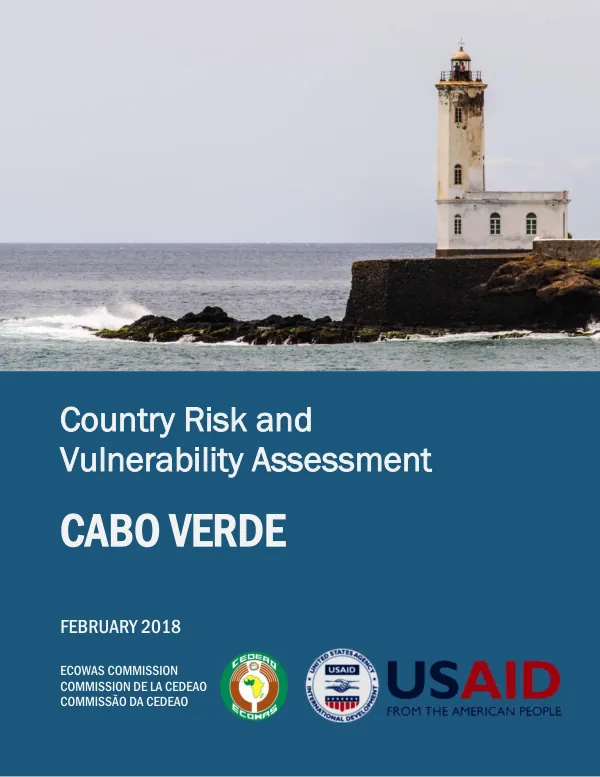
Country Risk and Vulnerability Assessment: Cabo Verde
The Cabo Verde Country Risk and Vulnerability Assessment was conducted in February 2018 by the ECOWAS Commission.
2018 · 70 pages
Sign in to readA free account is required to download.
Abstract
The assessment aimed to identify and analyze the country's vulnerabilities, risks, and resilience factors. Cabo Verde is a member state of the Economic Community of West African States (ECOWAS), with a population of approximately 0.5 million people. The assessment identified four human security pillars: Rule of Law, Economics and Resources, Politics and Governance, Security, and Population and Demographics. The Rule of Law pillar was found to be the most vulnerable, with challenges related to the justice system, corruption, and human rights. The Economics and Resources pillar was the second most vulnerable, with issues related to poverty, unemployment, and limited economic diversification. The assessment also identified external factors that could impact Cabo Verde's stability, including climate change, natural disasters, and global economic trends. The report highlighted the importance of addressing these challenges to ensure the country's resilience and stability. The assessment was conducted through a combination of literature review, key informant interviews, and focus group discussions. The research sample included a range of stakeholders, including government officials, civil society organizations, and private sector representatives. The assessment identified several key findings, including the need for improved governance, economic diversification, and human rights protection. The report also highlighted the importance of addressing the root causes of poverty and unemployment, as well as the need for improved disaster risk management and climate change adaptation. The assessment recommended several actions to address the identified vulnerabilities and risks, including the development of a national strategy for economic diversification, the implementation of a justice sector reform program, and the establishment of a disaster risk management framework. The report also emphasized the need for improved coordination and collaboration among national and regional stakeholders to address the country's human security challenges. The assessment was conducted in collaboration with several international partners, including the United States Agency for International Development (USAID) and the United Nations Office on Drugs and Crime (UNODC). The report provides a comprehensive analysis of Cabo Verde's human security challenges and offers recommendations for addressing these challenges to ensure the country's stability and resilience. The assessment identified several sub-national level vulnerabilities, risks, and resilience factors, including those related to the islands of Sal, Santiago, and São Vicente. The report highlighted the importance of addressing these challenges at the local level to ensure the country's overall stability and resilience. Overall, the Cabo Verde Country Risk and Vulnerability Assessment provides a comprehensive analysis of the country's human security challenges and offers recommendations for addressing these challenges to ensure the country's stability and resilience. The report highlights the importance of improved governance, economic diversification, and human rights protection, as well as the need for improved disaster risk management and climate change adaptation.
Related documents