USAID
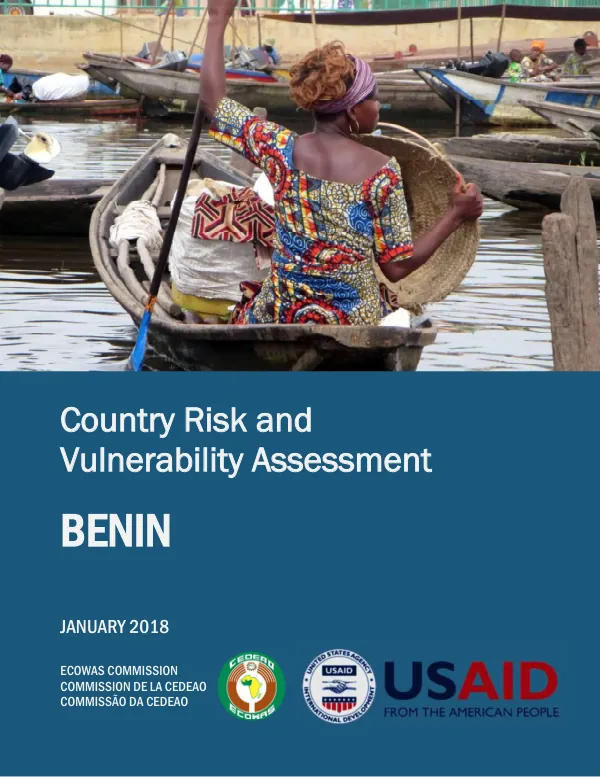
Country Risk and Vulnerability Assessment: Benin
The Country Risk and Vulnerability Assessment: Benin was conducted in January 2018 by the ECOWAS Commission.
2018 · 70 pages
Sign in to readA free account is required to download.
Abstract
The assessment aimed to identify structural vulnerabilities, event-driven risks, and existing resilience factors in Benin. The research leveraged ECOWARN data gathered by Field Monitors to establish a country baseline for monitoring patterns and trends across human security pillars. The assessment focused on four human security pillars: Economics and Resources, Population and Demographics, Politics and Governance, and Rule of Law. The Economics and Resources pillar highlighted Benin's vulnerability to economic shocks, with a high dependence on external aid and a fragile financial sector. The Population and Demographics pillar noted a high population growth rate, with a significant proportion of the population living in poverty. The Politics and Governance pillar identified challenges related to corruption, weak institutions, and a lack of transparency. The Rule of Law pillar highlighted issues related to the judiciary, with a lack of independence and a high level of corruption. The Security pillar, which was the least vulnerable, noted a relatively stable security situation, with a low level of conflict. The assessment also considered external factors, including global economic trends, climate change, and human migration. Gender considerations were also taken into account, with a focus on the impact of these factors on women and girls. The assessment identified sub-national level vulnerabilities, risks, and resilience factors, with observations by region. The Alibori Department was identified as a high-risk area, with a high level of poverty and a lack of access to basic services. The Borgou Department was also identified as a high-risk area, with a high level of corruption and a lack of transparency. The Littoral Department was identified as a moderate-risk area, with a relatively stable security situation and a growing economy. The Plateau Department was identified as a low-risk area, with a stable security situation and a growing economy. The assessment concluded that Benin faces significant challenges related to economic vulnerability, population growth, and governance. The report made recommendations for addressing these challenges, including strengthening institutions, improving transparency and accountability, and promoting economic diversification. The assessment also highlighted the need for a more robust early warning and response system to address emerging risks and vulnerabilities. The ECOWAS Commission has committed to consolidating the achievement of the CRVA by applying the knowledge and skills embodied in the CRVA Manual. The training of EWD staff in the development of the CRVA Index has marked the climax of the transfer of knowledge and skills from the USAID REWARD technical staff to ECOWAS. This will enable ECOWAS to independently conduct future CRVAs.
Related documents