INTERNATIONAL LIVESTOCK RESEARCH INSTITUTE
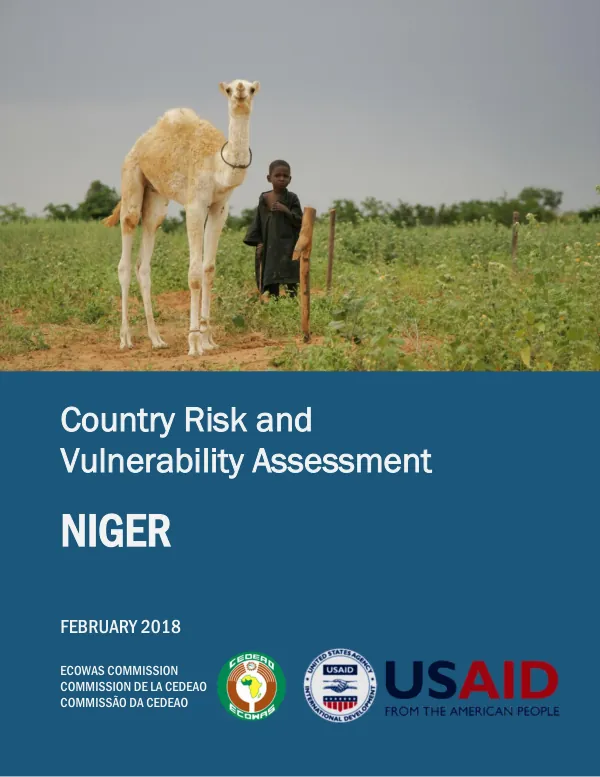
Country Risk and Vulnerability Assessment: Niger
The ECOWAS Commission conducted a Country Risk and Vulnerability Assessment in Niger in February 2018.
2018 · 93 pages
Sign in to readA free account is required to download.
Abstract
The assessment aimed to identify and analyze the country's vulnerabilities, risks, and resilience factors across various human security pillars. The research process involved a comprehensive literature review, data analysis, and fieldwork. The assessment identified four human security pillars: Economics and Resources, Population and Demographics, Security, and Politics and Governance. The Economics and Resources pillar was found to be the most vulnerable, with Niger facing significant challenges in terms of poverty, food insecurity, and limited access to basic services. The country's economy is heavily reliant on agriculture, which is vulnerable to climate change and market fluctuations. The Population and Demographics pillar was the second most vulnerable, with Niger experiencing rapid population growth and a high total fertility rate. This has put pressure on the country's resources, infrastructure, and services. The Security pillar was also identified as a significant risk, with Niger facing threats from terrorist groups such as Boko Haram and Al-Qaeda in the Islamic Maghreb. The Politics and Governance pillar was found to be the least vulnerable, with Niger having a relatively stable political system and a functioning government. However, the country still faces challenges in terms of corruption, poor governance, and limited access to justice. The Rule of Law pillar was also identified as a key area of concern, with Niger struggling to enforce laws and protect human rights. The assessment also examined external factors that affect Niger's vulnerability, including climate change, global economic trends, and regional conflicts. The report highlights the importance of addressing these external factors to mitigate Niger's vulnerability. Additionally, the assessment considered gender considerations, which are critical in understanding Niger's vulnerability, particularly in the areas of education, healthcare, and economic empowerment. The sub-national level vulnerabilities, risks, and resilience factors were also examined, with observations made for each of the eight regions in Niger. The assessment found that the Agadez Region was particularly vulnerable due to its remote location and limited access to basic services. The Diffa Region was also identified as a high-risk area due to its proximity to the border with Nigeria and the presence of terrorist groups. The report concludes by highlighting the need for a comprehensive approach to addressing Niger's vulnerability. The assessment recommends that the government, international partners, and civil society organizations work together to address the country's vulnerabilities, risks, and resilience factors. The report also emphasizes the importance of addressing the root causes of Niger's vulnerability, including poverty, inequality, and poor governance. The assessment provides a detailed matrix of vulnerabilities, risks, resilience factors, and recommendations by human security pillar, which can be used as a tool for policymakers and practitioners to develop targeted interventions. The report also includes additional references and data samples, which can be used for further analysis and research.
Related documents