SOCHA, LLC
COVID-19 THIRD-PARTY MONITORING REPORT
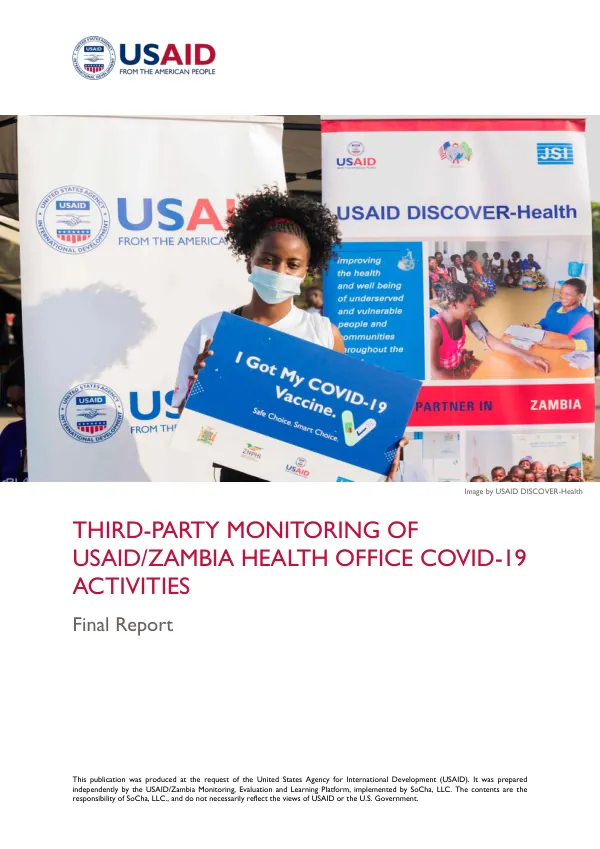
The COVID-19 response in Zambia was supported by the USAID/Zambia Health Office through three activities: the District Coverage of Health Services Project (DISCOVER-Health), Evidence for Health (E4H), and the Tuberculosis Local Organization Network (TBLON).
2023 · 61 pages
Sign in to readA free account is required to download.
Abstract
The Third-Party Monitoring (TPM) exercise, conducted by the Zambia Monitoring, Evaluation, and Learning Platform (Z-MELP) between June 12, 2023, and October 1, 2023, focused on the support provided through these activities in five provinces: Central, Copperbelt, Lusaka, Northwestern, and Southern. The TPM involved a document review, Key Informant Interviews (KIIs), Group Discussions with beneficiaries, and structured observation and document review at facilities. The exercise addressed four objectives: conducting an effectiveness review of the Mission's COVID-19 support, carrying out forward-looking site integration monitoring, undertaking context monitoring, and ascertaining the available skills at supported health facilities for COVID-19 data management and reporting in the COVAX system. Respondents perceived the provision of material assistance, particularly transportation assistance, as the most effective aspect of the COVID-19 support. The provision of transport assistance addressed the initial challenges faced by the Ministry of Health (MOH) in planning its COVID-19 response, including a lack of transport to get staff from facilities to communities for COVID-19 sensitization efforts and to administer vaccines. Other types of material assistance, such as the provision of tablets and laptops, airtime and data bundles, Personal Protective Equipment (PPE), and materials for RCCE activities, were also valued. Capacity strengthening, particularly health facility clinicians, was the second most effective component of the COVID-19 support. The support provided by E4H around data management and data entry into the DHIS2 COVAX system was prized, as it allowed facilities to own their data and review it in near real-time. The support provided by TBLON on case management for critically ill patients was also valued, as it provided knowledge and skills that could be beneficial in dealing with future health emergencies. The collaborative approach taken by the three USAID/Zambia Activities to their engagement with local counterparts (MOH/PHO/DHO/facility Staff) was the third most effective component of the Mission's COVID-19 support. This engagement was characterized by strong local ownership and clear recognition that while the Activities would play an advisory role and provide concerted support, it would be the MOH that would provide direction to the overall COVID-19 response. However, the TPM identified areas where improvements were necessary. The payment and incentive structures put in place for Community-Based Volunteers (CBVs) were a concern, as CBVs often lacked reliable transport, supplies, or subsistence allowances to cover meal costs. Concerns were also raised by CBVs about their allowances from DISCOVER-Health being tied to the meeting of timebound vaccination targets that were not necessarily realistic. The TPM also found that RCCE campaigns struggled to gain traction in the later stages of the COVID-19 response and have continued to struggle post-pandemic. This finding was not province-specific but emerged more strongly in districts that could be deemed "remote" in terms of their distance from urban hubs. Perceptions that "the pandemic is over" remain rife in these locations, and RCCE campaigns have faced ongoing challenges due to the continuing proliferation of vaccine and wider COVID-19 misinformation.