USAID DEC
Creating an Enabling Environment for Task Shifting in HIV and AIDS Services: Recommendations Based on Two African Country Case Studies
Sign inJOINT UNITED NATIONS PROGRAMME ON HIV/AIDS , GENEVA
Creating an Enabling Environment for Task Shifting in HIV and AIDS Services: Recommendations Based on Two African Country Case Studies
The World Health Organization (WHO) estimates that the WHO African Region has a shortfall of 817,992 doctors, nurses, and midwives, necessitating a more than doubling of the workforce among these professional categories.
2010 · 4 pages
Sign in to readA free account is required to download.
Abstract
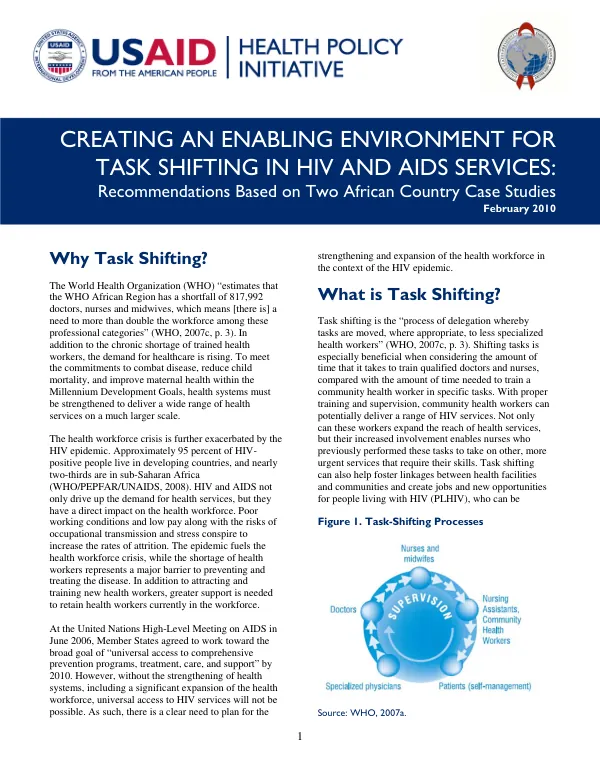
The demand for healthcare is rising, and health systems must be strengthened to deliver a wide range of health services on a larger scale to meet the commitments to combat disease, reduce child mortality, and improve maternal health within the Millennium Development Goals. The health workforce crisis is exacerbated by the HIV epidemic, with approximately 95 percent of HIV-positive people living in developing countries, and nearly two-thirds residing in sub-Saharan Africa. HIV and AIDS drive up the demand for health services, and have a direct impact on the health workforce, increasing rates of attrition due to poor working conditions, low pay, occupational transmission, and stress. The epidemic fuels the health workforce crisis, while the shortage of health workers represents a major barrier to preventing and treating the disease. Task shifting is the process of delegation whereby tasks are moved, where appropriate, to less specialized health workers. This approach is beneficial when considering the time it takes to train qualified doctors and nurses compared to training community health workers in specific tasks. With proper training and supervision, community health workers can potentially deliver a range of HIV services, expanding the reach of health services and enabling nurses to take on more urgent services that require their skills. The WHO launched the "Treat, Train, Retain" plan in August 2006 to strengthen and expand the health workforce by addressing both the causes and the effects of HIV and AIDS on health workers. In January 2008, the WHO, Joint United Nations Program on HIV/AIDS (UNAIDS), and President's Emergency Plan for AIDS Relief (PEPFAR) developed global recommendations and guidelines for task shifting, providing overall guidance to countries considering adopting or expanding a task-shifting approach. Case studies in Swaziland and Uganda were conducted to obtain a better understanding of the task-shifting approaches and policies in these countries. The studies involved interviews and focus group discussions with various service providers, as well as desk reviews of available documents and policies. Key findings from the studies include the informal nature of task shifting in Swaziland, where task shifting occurs without a national policy, and the structured introduction of task shifting in Uganda, where community health workers are well prepared, supervised, and mentored. Despite these promising approaches, challenges and issues arise, including the lack of formal quality assurance frameworks, conflicts between job descriptions, and the overloading of nurses. In Uganda, task shifting is driven by shortages in human resources for health and the high demand for healthcare services, and nurses have taken on increasingly more clinical responsibilities beyond the scope of traditional nursing work.
Related documents