USAID DEC
Creation of social and cultural centers as an efficient resource of social and economic development of local communities
Sign inUSAID DEC
Creation of social and cultural centers as an efficient resource of social and economic development of local communities
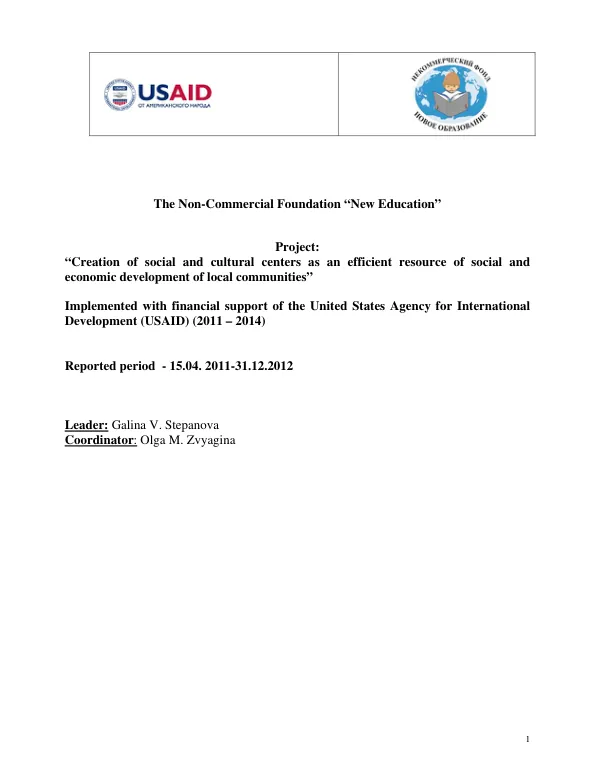
The Non-Commercial Fund "New Education's" project, "Creation of social and cultural centers as an efficient resource of social and economic development of local communities," was implemented with financial support from the United States Agency for International Development (USAID) from 2011 to 2014.
2012 · 12 pages
Sign in to readA free account is required to download.
Abstract
The project aimed to attract the population to active social life, participation in decision-making, and execution in close cooperation with authorities. The project's strategic objectives included supporting and developing the non-commercial sector in the Republic of Karelia, developing and testing the SCC model, programs, and technology, and disseminating the project's results on the regional and interregional level. The project's main activities focused on supporting and developing the non-commercial sector, strengthening the material and technical basis of the Segezha and Kalevala centers, and providing consulting and methodological assistance to prepare Social and Cultural Centers/Civic Centers in other regions. The Center for Non-Commercial Organizations Assistance (CNCOA) in Petrozavodsk provided informational meetings, negotiations, seminars, and consultations with authorities, non-commercial funds, and society. The CNCOA also rendered consulting and methodological assistance to 35 non-commercial organizations and institutions, resulting in 27 applications to the "Active Generation" fund, 12 applications to the State Committee on National Affairs, and 5 social projects initiated by youth initiatives groups. The project's results included the establishment of 20 non-commercial organizations and initiative groups, training of 8 project coordinators of Social and Cultural Centers/Civic Centers, and the holding of a workshop for NGOs on new legislation on non-profit organizations. The project also involved the population into community problem-solving, with 425 participants taking part in events on the basis of the center in Segezha. The project's main events in Segezha included the "Inter-sector social dialogue" round table, the "Social star" contest, and the opening of the Center. The project's results in Segezha included the establishment of a new NGO, the submission of applications to the project tender of the Government of the Republic of Karelia, and the initiation of five social projects by youth initiatives groups. The project's main achievements included the establishment of the socio-cultural center in Segezha, the strengthening of the material and technical basis of the center, and the provision of a work site for local NGOs. The project's results also included the involvement of the population into community problem-solving, with 425 participants taking part in events on the basis of the center in Segezha. The project's main challenges included the absence of any structure uniting NGOs and involving NGOs in socio-economic activities. However, the project's success was achieved through the establishment of the Social and Cultural/Civic Center on the basis of the city Culture and Free-Time Centre in Segezha, providing a work site for local NGOs, and involving them in socio-economic activities. The project's main recommendations included the establishment of a structure uniting NGOs and involving NGOs in socio-economic activities, the provision of a work site for NGOs, and the involvement of the population into community problem-solving. The project's results demonstrated the efficiency of the SCC model, programs, and technology in promoting social and economic development of local communities.
Related documents