USAID. MISSION TO CAMEROON
Credit union development, phase II
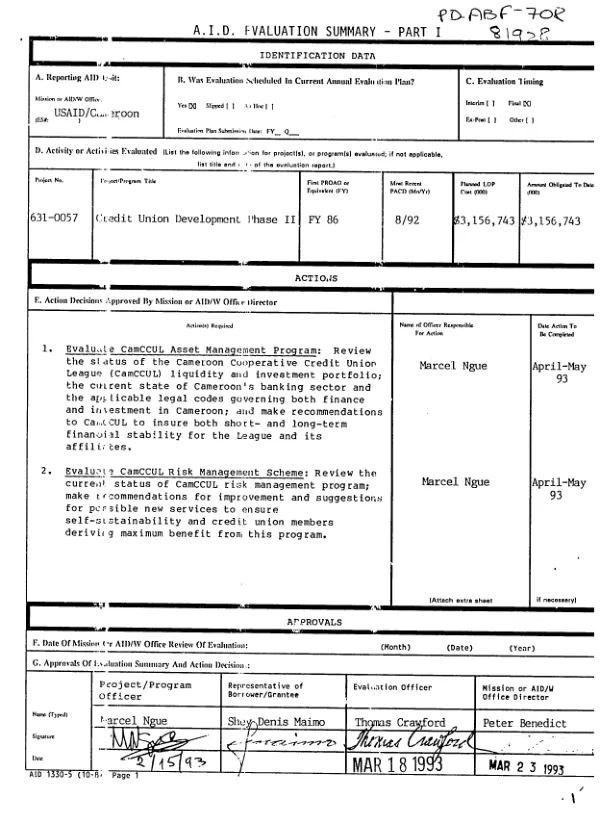
Summarizes a final evaluation, conducted a few months before PACD, of a 1986-92 project to assist the Cameroon Cooperative Credit Union League (CamCCUL) in strengthening its credit union (CU) network and member services.
1993
Sign in to readA free account is required to download.
Abstract
The project generally achieved its goal of increasing the technical and institutional capabilities of CamCCUL and member CUs, as well as increasing awareness of the CU movement among both members and non-members. This has resulted in a strengthened national and regional CU structure, expansion of the CU network served by CamCCUL, and better, more sophisticated, financial services for CamCCUL members. CamCCUL has grown from 65 groups with 4,000 members, and $60,000 in savings in 1969, to 255 credit unions, with 75,600 members (one-third of whom are women), and the equivalent of $32 million in savings. However, additional analysis is needed to quantify and understand the people-level impact more specifically. Recent economic recession and political turmoil in Cameroon have restricted CamCCUL"s ability to function, so that quantitative achievements for the project period are somewhat below target; nevertheless, CamCCUL has demonstrated remarkable resilience in a turbulent environment. This can be attributed to its excellent management and the high degree of confidence that it engenders in member CUs. CamCCUL -- with a total of 14 years of USAID assistance -- has achieved a high degree of maturity and financial and operational self-sufficiency. The League and its members must now reassess several key issues, e.g., whether it should expand geographically, replace its historical emphasis on safety and savings accumulation with more productive use of assets, and increase professional staff and decrease dependence on volunteers, in order to ensure CamCCUL"s sustainability as an independent, private sector institution. Many in CamCCUL have expressed the concern that they are not fully prepared for the withdrawal of USAID support. The evaluation recommends that USAID consider providing limited short-term TA. Lessons learned included the following. (1) It is important for USAID managers and the recipient of a USAID grant -- which requires less USAID managerial control than a contract -- to agree on monitoring, reporting, and supervisory responsibilities at the start of a project in order to avoid misunderstandings later. (2) USAID has a supportive role in the CU movement beyond the PACD, especially with regard to other rural finance projects (e.g., small and medium-size enterprises and cooperative law).