ENVIRONMENTAL INCENTIVES, LLC
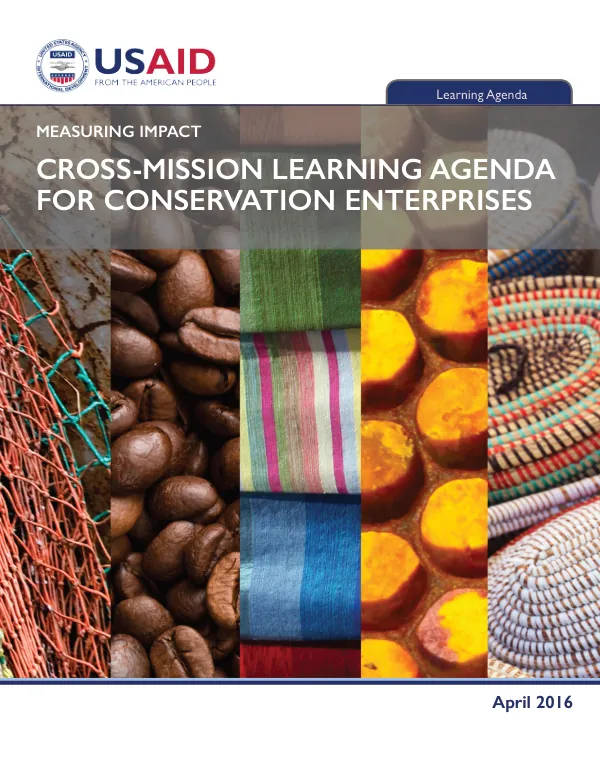
Cross-Mission Learning Agenda for Conservation Enterprises
Conservation enterprises are a common component of USAID biodiversity activities, aiming to create an economic incentive for stakeholders to reduce threats to biodiversity.
2016 · 16 pages
Sign in to readA free account is required to download.
Abstract
These enterprises involve the production of goods from nature, such as honey, and services, like tourism, generating income and non-cash benefits for stakeholders. The motivation and ability for stakeholders to change their behavior, such as improving resource management or discontinuing overuse, are also provided by conservation enterprises. The ultimate goal of these enterprises is to reduce threats and improve the status of biodiversity. A generalized theory of change for conservation enterprises was developed based on a review of USAID documents, published and grey literature, and input from USAID staff. The theory of change includes key assumptions that will be explored by the Learning Group. The first assumption is that if enabling conditions, such as market potential verification, are in place, then enterprise revenues and sustainability will follow. The second assumption is that if the enterprise generates revenues and is sustainable, stakeholders will realize benefits, primarily a marginal increase in income, but also additional non-cash benefits. The third assumption is that if stakeholders realize benefits from the enterprise, they will be motivated and able to change their behavior, such as discontinuing unsustainable activities and excluding others from unsustainable uses that result in threats to biodiversity. The Learning Agenda for Conservation Enterprises is a strategy for continuous learning, implemented by USAID's Bureau for Economic Growth, Education, and Environment/Office of Forestry and Biodiversity (E3/FAB) to increase the effectiveness of strategic approaches in biodiversity programs. The Learning Agenda defines specific learning questions that a Learning Group will collaborate to answer, the learning activities involved, and the intended learning products and outcomes. The Learning Agenda takes a community of practice approach to knowledge creation, sharing, and synthesis, with Collaborative Learning Groups developing and pursuing shared Learning Agendas with support from E3/FAB's Measuring Impact (MI) activity. The Learning Agenda is framed around the specific theory of change underlying a common strategic approach, which articulates how a team believes a set of actions or strategic approach will lead to the desired outcomes. The Learning Program uses results chain diagrams as a tool to illustrate theories of change, making explicit the expected results and any underlying assumptions, and to identify learning questions based on those assumptions. The Learning Agenda aims to build the evidence base about the effectiveness of conservation enterprise approaches across USAID Mission programming, addressing the need and opportunity to test key assumptions regarding the effectiveness of this approach. A Learning Agenda defines the specific learning questions that a Learning Group will collaborate to answer, the learning activities involved, and the intended learning products and outcomes. The Learning Agenda is a critical component of the Learning Program, which aims to improve understanding of the conditions under which a specific strategic approach is successful in achieving desired outcomes, and why. The Learning Agenda will help inform what works, what does not, and why, providing valuable insights for USAID biodiversity programming.
Related documents