USAID
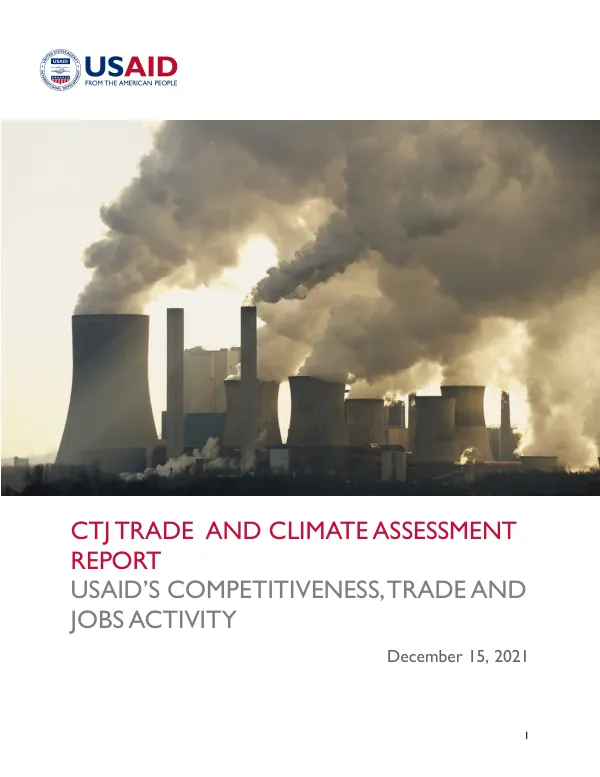
CTJ TRADE AND CLIMATE ASSESSMENT REPORT
The USAID Trade Central Asia (TCA) project aims to facilitate trade and employment in horticulture, tourism, transport, and logistics across the five Central Asian economies.
2021 · 18 pages
Sign in to readA free account is required to download.
Abstract
The project's five-year duration spanned from October 2016 to December 2021, with the primary goal of expanding regional trade and employment in these sectors. The project's scope of work focused on incentivizing firms to become more regionally competitive and addressing cross-border impediments to trade. Climate change is a significant concern in Central Asia, with the region being highly vulnerable to its impacts. Average temperatures in the region have been increasing at a rapid rate, with some areas experiencing temperature rises of up to 0.8-1.3°C over the past 100 years. The rapid pace of global warming is expected to continue, with temperatures projected to increase by 3 to 6 degrees Celsius by the end of this century. The melting of glaciers has also accelerated, with Central Asian glaciers shrinking by 25% and expected to shrink by another 25% over the next twenty years. The impacts of climate change in Central Asia are multifaceted, with heatwaves, droughts, and floods being the most significant hazards. Agriculture, water resources, and human health are among the economic sectors most affected by climate change. The region's glaciers and snowfields are projected to decline significantly, with major implications for the country's water resources. The current rate of glacier loss in Central Asia is between 0.2 – 1% per year, with the region's glaciers expected to shrink by another 25% over the next twenty years. The National Determined Contributions (NDCs) of the five Central Asian Republics (Kazakhstan, Kyrgyz Republic, Tajikistan, Turkmenistan, and Uzbekistan) are critical in addressing climate change issues. The NDCs outline each country's emissions-reduction targets, with the goals of keeping global temperature rise below 2 degrees Celsius and pursuing efforts to keep it below 1.5 degrees Celsius. The Paris Agreement, which was reached in 2015, requires both developed and developing countries to set emissions-reduction targets. The TCA project can play a crucial role in supporting the Central Asian Republics in addressing climate change issues. The project can help each country address climate change issues as they relate to their respective NDCs and TCA's scope of work. Potential areas of opportunity for TCA to address climate change issues include supporting the development of climate-resilient infrastructure, promoting sustainable agriculture practices, and enhancing the region's climate change knowledge and capacity. The TCA project can also support the development of climate-resilient infrastructure, such as roads, bridges, and buildings, that can withstand the impacts of climate change. This can be achieved through the provision of technical assistance, training, and capacity-building programs for government officials, private sector companies, and civil society organizations. In addition, the TCA project can promote sustainable agriculture practices that are resilient to climate change. This can be achieved through the provision of technical assistance, training, and capacity-building programs for farmers, agricultural extension agents, and other stakeholders. The project can also support the development of climate-resilient agricultural technologies, such as drought-tolerant crops and climate-resilient irrigation systems. Furthermore, the TCA project can enhance the region's climate change knowledge and capacity. This can be achieved through the provision of technical assistance, training, and capacity-building programs for government officials, private sector companies, and civil society organizations. The project can also support the development of climate change research and development programs, as well as the establishment of climate change monitoring and early warning systems. In conclusion, the TCA project has a critical role to play in supporting the Central Asian Republics in addressing climate change issues. The project can help each country address climate change issues as they relate to their respective NDCs and TCA's scope of work. By supporting the development of climate-resilient infrastructure, promoting sustainable agriculture practices, and enhancing the region's climate change knowledge and capacity, the TCA project can contribute to the achievement of the Paris Agreement's goals and help the region build a more climate-resilient future.
Related documents