POPULATION REFERENCE BUREAU
Cuba: Country Profile
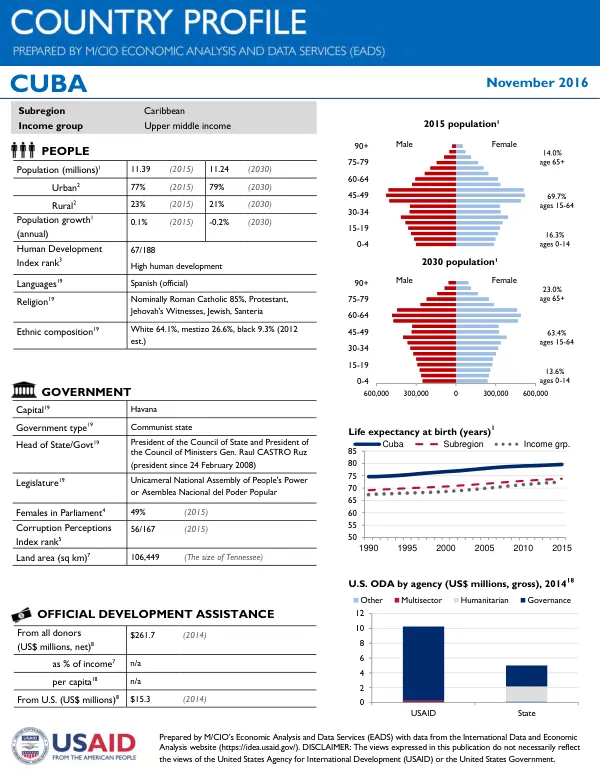
Cuba is an island nation located in the Caribbean, with a population of approximately 11.39 million people as of 2015.
2016 · 2 pages
Sign in to readA free account is required to download.
Abstract
The country is classified as an upper-middle-income economy and has a high human development index rank of 67 out of 188 countries. The population is predominantly urban, with 77% of the population residing in urban areas as of 2015, and is expected to increase to 79% by 2030. The country has a diverse ethnic composition, with the majority being white (64.1%), followed by mestizo (26.6%), and black (9.3%) populations. The official language is Spanish, and the majority of the population is nominally Roman Catholic, with a significant minority practicing other religions. The government is a communist state, with President Raul Castro Ruz serving as the head of state and government since 2008. Cuba has made significant progress in education, with a primary gross completion rate of 97.7% in 2014, and a female completion rate of 100%. The country has also achieved a high level of youth literacy, with a youth literacy rate of 100% among individuals aged 15-24 in 2015. However, there are still challenges in education, with 53,245 children out of school in primary education in 2014. The country's economy is primarily driven by services, with a GDP of $77,150 million in 2013. The country has a relatively low level of merchandise exports, with $3,030 million in 2015, and a higher level of merchandise imports, with $11,721 million in 2015. The country has a relatively low level of poverty, with 7.1% of the population aged 15-24 being unemployed in 2014. In terms of health, Cuba has made significant progress in reducing the prevalence of HIV, with a prevalence rate of 0.3% among individuals aged 15-49 in 2015. The country has also achieved a high level of antiretroviral coverage, with 69% of adults aged 15 and above meeting WHO guidelines in 2015. However, the country still faces challenges in reducing child and maternal mortality, with a child mortality rate of 14 per 1,000 live births in 2015, and a maternal mortality rate of 50 per 100,000 live births in 2015. Cuba has received official development assistance from various donors, with $261.7 million in net disbursements in 2014. The country has also received assistance from the United States, with $15.3 million in net disbursements in 2014. The country's public health expenditure is relatively high, with 11% of GDP allocated to public health in 2014.
Related documents