USAID
Comparison of Delaware and the Dominican Republic
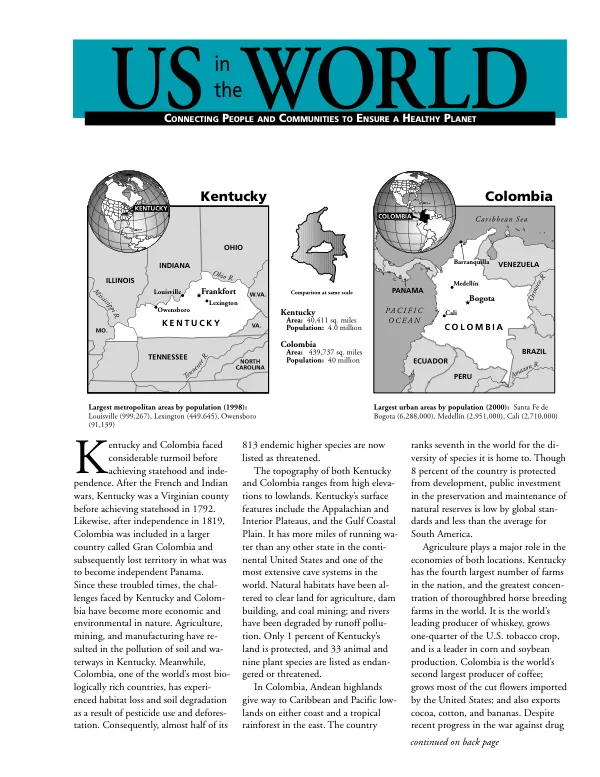
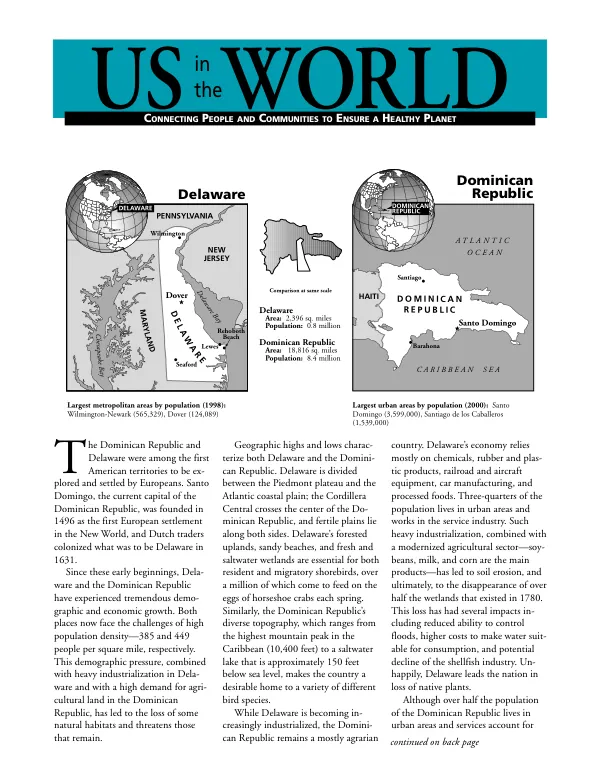
The state of Delaware and the Dominican Republic share a common history as early American territories explored and settled by Europeans.
4 pages
Sign in to readA free account is required to download.
Abstract
Delaware was colonized by Dutch traders in 1631, while the Dominican Republic's capital, Santo Domingo, was founded in 1496 as the first European settlement in the New World. Both places have experienced significant demographic and economic growth since their early beginnings. Delaware is characterized by a diverse geography, divided between the Piedmont plateau and the Atlantic coastal plain. The state's forested uplands, sandy beaches, and fresh and saltwater wetlands support a wide range of wildlife, including over a million migratory shorebirds that feed on the eggs of horseshoe crabs each spring. In contrast, the Dominican Republic's topography ranges from the highest mountain peak in the Caribbean to a saltwater lake approximately 150 feet below sea level, making it a desirable home to a variety of bird species. Delaware's economy has shifted from a primarily agrarian society to a more industrialized state, with a focus on chemicals, rubber and plastic products, railroad and aircraft equipment, car manufacturing, and processed foods. This industrialization has led to soil erosion and the disappearance of over half the wetlands that existed in 1780, resulting in reduced flood control, higher water treatment costs, and potential decline of the shellfish industry. In contrast, the Dominican Republic remains a mostly agrarian country, with a focus on soybeans, milk, and corn as main products. Both Delaware and the Dominican Republic face challenges related to high population density, with 385 and 449 people per square mile, respectively. This demographic pressure, combined with industrialization and agricultural demands, has led to the loss of natural habitats and threatens those that remain. Delaware has 19 endangered and threatened species, including the Delmarva Peninsula fox squirrel and the piping plover, while the Dominican Republic has 28 threatened animal species and 73 threatened plant species. Delaware's population is projected to grow by 10% by 2025, with a doubling time of 54 years. The state's per capita gross state product was $43,174 in 1997, the highest in the nation. In contrast, the Dominican Republic's population is projected to grow by 45% by 2025, with a doubling time of 39 years. The country's GDP per capita is $1,882, less than half the average for Latin America and the Caribbean. The Dominican Republic has a high rate of infant mortality, with one in every 21 infants not surviving to its first birthday. However, conditions have improved from the early 1950s, when the rate was three times higher. The country has made progress in immunizing children against diseases such as diphtheria, pertussis, tetanus, and polio, but rates are lower than those for Latin America and the Caribbean. The Dominican Republic has a rich biodiversity, with 5,000 known species of higher plants and 136 known species of birds, including several threatened or endangered species found only in the country and contiguous Haiti.