USAID DEC
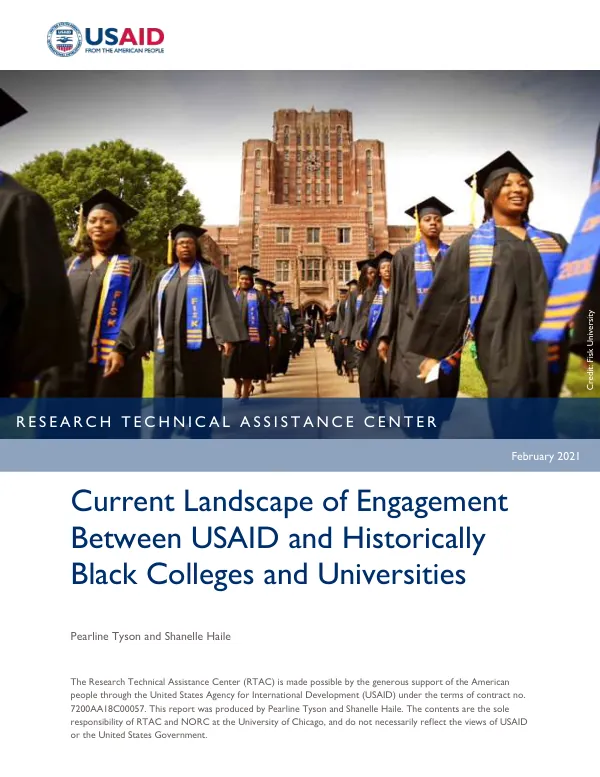
Current Landscape of Engagement Between USAID and Historically Black Colleges and Universities
Sign inARIZONA STATE UNIVERSITY
Current Landscape of Engagement Between USAID and Historically Black Colleges and Universities
Historically Black Colleges and Universities (HBCUs) play a vital role in the education and development of Black students in the United States.
2021 · 72 pages
Sign in to readA free account is required to download.
Abstract
Despite representing only three percent of all four-year nonprofit colleges and universities, HBCUs enroll 10 percent of all Black students nationwide, award 26 percent of all Black bachelor's degrees, and 32 percent of all Black bachelor's degrees in science, technology, engineering, and mathematics (STEM) fields. Additionally, HBCUs employ 96 percent of Black faculty as professors. The Research Technical Assistance Center (RTAC) conducted a study to analyze the current landscape of USAID's engagement with HBCUs. The study aimed to strengthen the partnership between USAID and HBCUs, as well as assess the international and transnational partnerships HBCUs have established with governmental and nongovernmental entities around the world. The Bronfenbrenner Ecological Systems Theory framework was used to analyze data collected during the desk review, interviews, and survey analyses. The study found that both HBCUs and USAID have barriers to partnering, including capacity, outreach, international experience, and knowledge of USAID programs and HBCUs. The report identifies several thematic barriers, including HBCU readiness, communication, outreach, and knowledge sharing, benchmarks and progress, and HBCU capacity. Recommendations for USAID to consider include promoting HBCU tiers of readiness, enhancing MSI international cooperation capacity, and setting short- and long-term goals for HBCU engagement. The study also highlights the importance of increasing engagement and improving the competitiveness of faculty, staff, and students at HBCUs. USAID has the opportunity to develop and harness the skills and expertise of HBCU faculty, staff, and students, who can provide culturally competent practices to USAID Missions, Bureaus, or Independent Offices (M/B/IOs) as they become the next generation of USAID civil and Foreign Service employees. The benefits of partnering with HBCUs are timely and boundless. By increasing partnerships with HBCUs, USAID can engage underrepresented students in their hiring pipelines and underrepresented faculty in development and research projects. The study provides a foundation for future research, including comparing the barriers experienced by HBCUs with the barriers experienced by non-HBCUs and assessing HBCU institutional capacity for USAID funding. The study's findings and recommendations have significant implications for USAID's engagement with HBCUs. By addressing the barriers to partnering and increasing engagement, USAID can leverage the skills and expertise of HBCU faculty, staff, and students to achieve its development goals and promote cultural competence in its operations.