USAID DEC
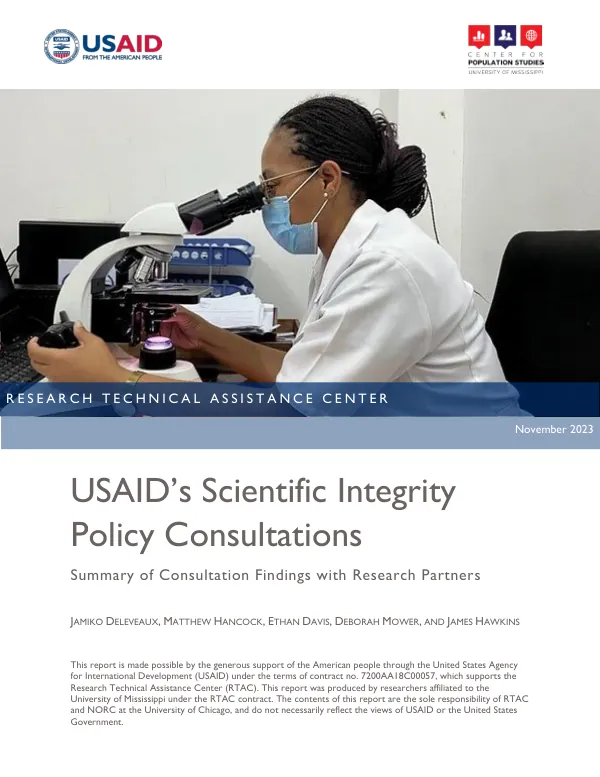
USAID’s Scientific Integrity Policy Consultations. Summary of Consultation Findings with Research Partners
Sign inARIZONA STATE UNIVERSITY
USAID’s Scientific Integrity Policy Consultations. Summary of Consultation Findings with Research Partners
The USAID Scientific Integrity Policy Consultations were conducted in June and July 2023 to gather input from domestic and international stakeholders on the development of a robust and technically sound scientific integrity policy.
2023 · 24 pages
Sign in to readA free account is required to download.
Abstract
The primary audience for the consultation sessions was the USAID team tasked with developing the scientific integrity policy. The consultations aimed to assist USAID in building a scientific integrity policy centered on nine core principles: Access to Science, Accountability, Free Flow of Scientific Information, Retaliation Protections, Science-Informed Decision-Making, Science Protections, Scientific Dissent, Technical Workforce, and Transparent Federal Advisory Committees. The research team used four data collection methods to solicit input from USAID's domestic and international stakeholders, including group interviews, in-call polls, online boards for written input, and choice ranking. A total of 113 invitations to participate in the consultations were sent to research implementing partners across sectors, with 65 participants attending consultation sessions. The study identified three limitations: a lower-than-expected response rate, technology barriers for participants, and selection bias. Research implementing partners identified the Agency's strengths and weaknesses in relation to the nine core USAID principles on scientific integrity. The top three strengths selected during the live poll were Access to Science, Free Flow of Scientific Information, and Technical Workforce. Agency weaknesses, according to participants' votes, were Science-Informed Decision-Making, Scientific Dissent, and Technical Workforce. Participants shared a universal concern regarding the strength of USAID's technical workforce and the potential for political interference in the decision-making process. A key issue noted by respondents is that for USAID to be successful, the Agency needs to expand the pool of potential partners they work with. According to one respondent, "USAID has a strong preference for who they want their researchers to be; strong candidates are looked over because they are not in a small pool of candidates that they trust and work closely with." If USAID is to be successful in the future, building inroads with academia will be an important factor in turning its science-informed decision-making and technical workforce weaknesses into strengths. Implementing partners faced various internal and external barriers when conducting research in support of USAID-funded projects. Common obstacles were identified across all sessions, including publishing research results, proposing research ideas, final reporting to research funders, presenting research to peers, and managing research projects and programs. A key finding associated with barriers was in relation to the time needed versus the time allotted to conduct research on a USAID-funded activity. Overall, participants identified the need for advancing processes and policy in securing access to science and the free flow of scientific information in respect to USAID projects. Moving forward in the development of USAID's scientific integrity policy, protecting the free flow of scientific information to the public, political, and academic communities will be essential in safeguarding the continued success and respect for the work of USAID. Recommendations were developed based on participants' responses, including creating inclusive, multi-stakeholder networks and partnerships, providing scientific integrity training for USAID staff, providing clear guidance on reporting scientific integrity issues, and streamlining reporting and publication processes. These recommendations aim to support the development of a robust and technically sound scientific integrity policy for USAID.