UNIVERSIT6 DE PURDUE
Data for Decision: Enhancing Water Security in Tanzania
Water security refers to the capacity to have enough water of sufficient quality and at the right time to support livelihoods, ecosystems, and economic activities.
2023 · 3 pages
Sign in to readA free account is required to download.
Abstract
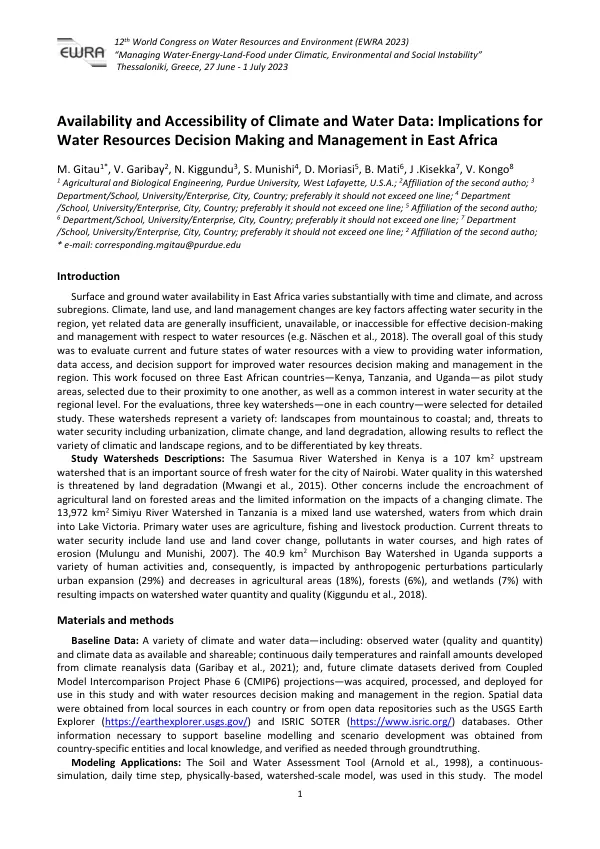
In Tanzania, water security is well enshrined in the National Water Policy of 2002 and the Water Resources Management Act, No. 11, 2009, amended in 2022. The latter recognizes water, particularly safe drinking water, as a basic human right essential for life. Section 22 (1) of the Act provides a framework for managing water resources through Basin Water Boards. The Water Utilization (Control and Regulation) Act of 1974 states that all water in the country is owned by the United Republic of Tanzania, with everyone having the right to use it but not the right to own it. This right to use water is supplemented by a prohibition to pollute water, as highlighted in Tanzania's Water Laws (Miscellaneous Amendments) Act Number 8 of 1997, Section 29(d). A water security project was implemented in three countries in East Africa, including Tanzania, Uganda, and Kenya, under the leadership of Purdue University with financial support from LASER PULSE. The project's overall goal was to provide water information, data access, and decision support to improve water security in East Africa. In Tanzania, the project was implemented in the Simiyu Catchment. The Simiyu River Watershed is part of the larger Lake Victoria basin, with the Simiyu River draining into Lake Victoria. The catchment is significant as it contributes a great deal of agriculture, fishing, and livestock keeping, thus supporting food security in the country. The catchment covers a total area of 10,659 km2 and is located between Simiyu and Mwanza regions in Tanzania. The annual rainfall of the catchment ranges between 700 mm to 1000 mm, with an average temperature ranging between 22.5 ºC and 23 °C. The inhabitants of the catchment are highly dependent on rain-fed agriculture and livestock production. The water towers of the Simiyu River Watershed originate from the Serengeti National Park and the Maswa Game Reserve, which are world-famous tourist attractions. The presence of a national park in the catchment generates human-wildlife interaction that requires proper management to ensure the sustainability of the ecosystem. Thirty years ago, the Simiyu River catchment used to be vegetative, with umbrella-like thick tree canopies. Such extensive vegetation moderated the catchment hydrological cycle, where water was abundant for wild animals, economic activities, and the environment. With population growth, there has been a progressive increase in cultivated and built-up areas, and most of the forest cover has disappeared. This has led to increased overland flows, leading to enhanced flood events and an increase in sediment loads. The Simiyu Catchment hosts major wetlands on which local communities rely for their livelihood. Changes in land use as a result of increased anthropogenic activities in a changing climate have jeopardized the integrity of the Simiyu Catchment resources. Increased point and non-point pollution from domestic, industrial, and agricultural activities is contributing to siltation and eutrophication of the Simiyu River system. Climate projections in the catchment have indicated a rise in total annual precipitation and temperatures. Effective management of observed and projected impacts of climate change requires strategic interventions that involve multiple stakeholders. Immediate remedial efforts are required to increase the number of water sources for the communities in the catchment. Such efforts need to be aligned to the general population growth in the Simiyu Region, which indicates that the population of the region was 1.6 million in 2012 and is estimated to be 2.2 million in 2022. Some potential interventions include promoting rainwater harvesting in anticipation of the projected increase in precipitation and construction of underground water storage tanks, which can be made locally. Effective implementation of these interventions will require an integrated approach where different agencies, including the Lake Victoria Basin Water Board, local NGOs, and the relevant District Local Government Authorities in Simiyu Region, will need to map and identify priority areas before mobilizing requisite resources.