UNIVERSIT6 DE PURDUE
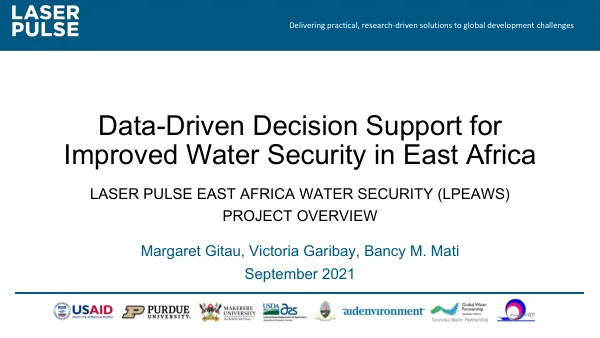
Data-Driven Decision Support for Improved Water Security in East Africa
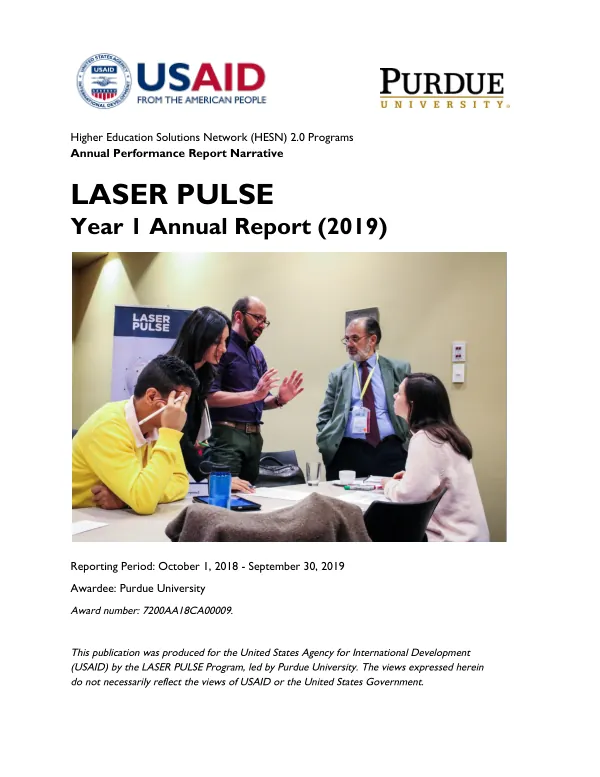
The LASER PULSE East Africa Water Security (LPEAWS) project is a research-driven initiative aimed at delivering practical solutions to global development challenges in East Africa.
2021 · 11 pages
Sign in to readA free account is required to download.
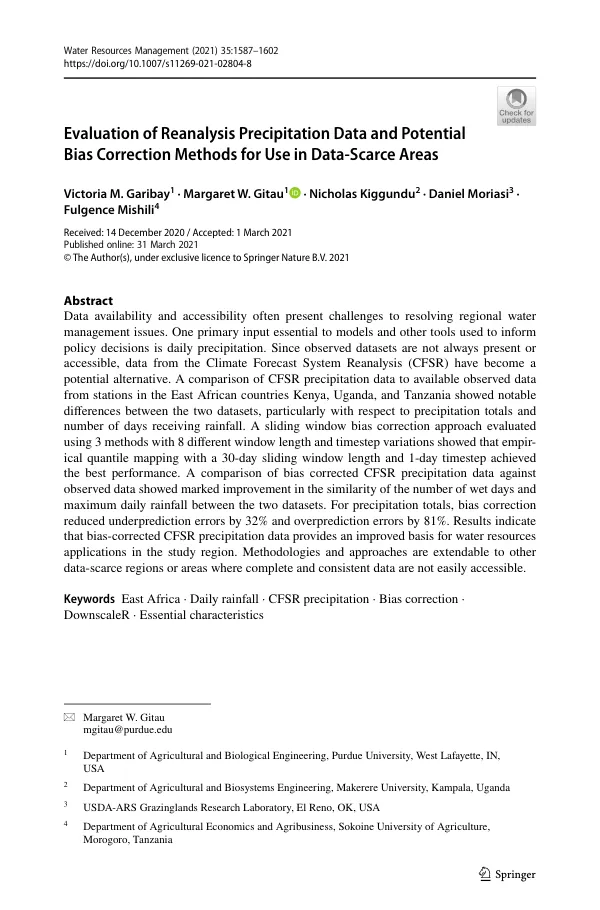
Abstract
The project focuses on improving water security through data-driven decision support. The research question guiding the project is what are the current and potential future states of water resources in the study areas. To address this question, the project employs a range of research methods, including the analysis of existing climate data and the use of SWAT modeling. Accessible datasets and actionable water information are also key components of the project. The research translation products include partner websites, social and professional media, stakeholder meetings, and training workshops. The project has conducted watershed case studies, which involve constructing hydrologic models and applying them to water resources decision making. These case studies highlight data types that warrant further attention. Targeted meetings have also been held with key stakeholders, including the USDA-ARS National Program Leader, the IGAD/ICPAC Director, and the Tanzania Director of Water and Direct Reports. One of the project's key highlights is the development of bias-corrected CFSR data for 12 stations in the study region, which is available for the period 1979-2019. This data has been published in an article titled "Evaluation of Reanalysis Precipitation Data and Potential Bias Correction Methods for use in Water Resources Applications in Data-Scarce Areas" in the journal Water Resources Management. The project has also conducted a climate and water data policy study, which involved surveying over 50 official legislation, documents, and websites in East Africa and beyond to identify common elements leading to or hindering free and effective access to data. The project has also developed a range of data products, which are available at https://purr.purdue.edu/. These data products include bias-corrected CFSR data, CMIP6 model comparisons, and other water-related data. The project has also conducted stakeholder meetings, which have provided insights into common challenges and opportunities surrounding data, access, and use. The project has identified several key issues related to data quality, including the range of data quality from high to low and frequent gaps in data. Funding for data collection is also insufficient, and there is an interest in modernizing and applying remote sensing. Human resources are also too few or insufficiently skilled. The project has also identified gaps in data usage for decision making, including the lack of equipment and equipment maintenance. Water quality perceptions vary widely based on specific location, and sampling is not conducted systematically. The project has also identified the intersection of data collection and policy, including the use of policies to set data quality standards but also negatively affecting data sharing abilities. The project has developed a framework for determining the success of a data stream, which is defined as proven free accessibility to the associated data resources. The project has also conducted individual watershed case studies, which provide workshop training opportunities. The project has also gathered data from different sources, favoring openly available software and data. Models will be calibrated using daily streamflow data, and calibration will be based on NSE and PBIAS. Different scenarios will be applied to demonstrate how models can inform water resources management decisions. The project has also developed watershed SWAT models, which will be used to provide example results, including watershed status, deficits and surpluses, future outlook, and water quality. These models will be used to demonstrate how data can inform water resources management decisions and improve water security in East Africa.