CHF
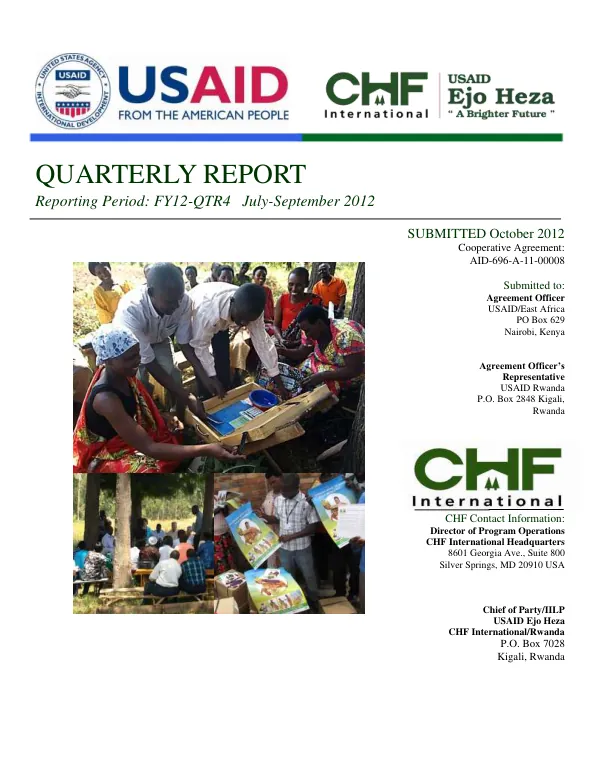
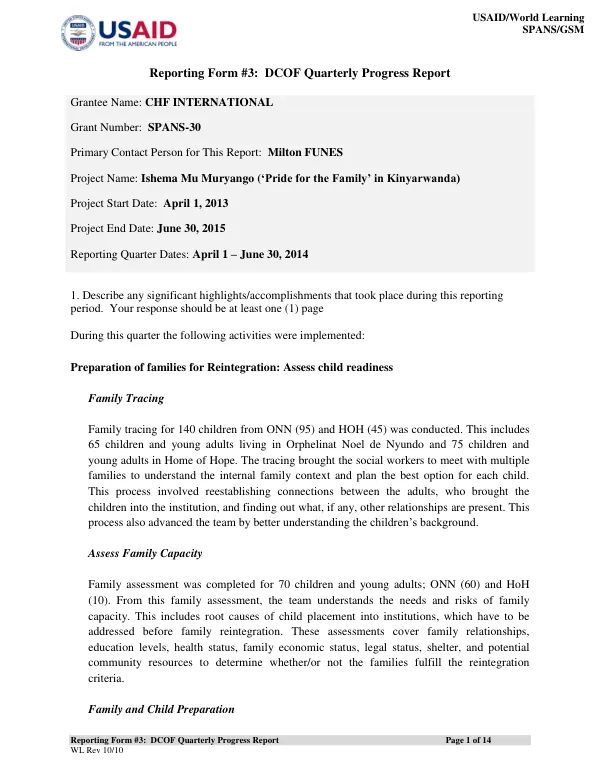
DCOF Quarterly Progress Report April-June 2014
The DCOF Quarterly Progress Report highlights significant accomplishments in the implementation of the Ishema Mu Muryango (IMM) project in Rwanda.
2014 · 14 pages
Sign in to readA free account is required to download.
Abstract
The project, led by CHF International, aims to support the deinstitutionalization of children from orphanages and homes of hope (HOH) through family-based care. During the reporting period, family tracing was conducted for 140 children from ONN (95) and HOH (45), resulting in the reestablishment of connections between adults and children. Family assessments were completed for 70 children and young adults, providing insight into family relationships, education levels, health status, and economic status. This information is crucial in determining whether families meet the reintegration criteria. Preparation of families for reintegration involved individual and group sessions with children and young adults, as well as with their families. Parent visiting children in institutions and children visiting families at home were also facilitated. As a result, 144 children and young adults, along with their families, were prepared to move out of institutional care into family-based care. Reintegration of children into healthy homes and schools was a significant achievement, with 89 children and young adults reintegrated during the reporting period. Of these, 84 were placed into alternative family-based care, prioritizing birth and extended families. Community volunteers were trained on various methodologies, including nutrition, food security, savings and lending groups, and early child development. Alternative care and prevention services were also implemented, with 75 foster caregivers identified and 58 assessed. Prevention of family separation and institutionalization was achieved through the emerging gatekeeping mechanism promoted in childcare networks. Community sensitization meetings were conducted, resulting in the extension of childcare networks from sector to cell level. Unforeseen obstacles and challenges were also addressed, including the challenge of reaching dispersed children placed into family-based care. To address this, the IMM team is setting up district clusters for mobile teams to provide community services. Alternative services were also provided for 24 young adults with disabilities through partnerships with local organizations. Significant program learning took place during the reporting period, including the importance of completing initial child assessments before undertaking subsequent activities. This informed the development of prevention strategies in areas identified as hotspots for children abandonment. The combination of prevention services and gradual transitioning of children from residential care into family-based care was identified as crucial for a successful deinstitutionalization program.