USAID DEC
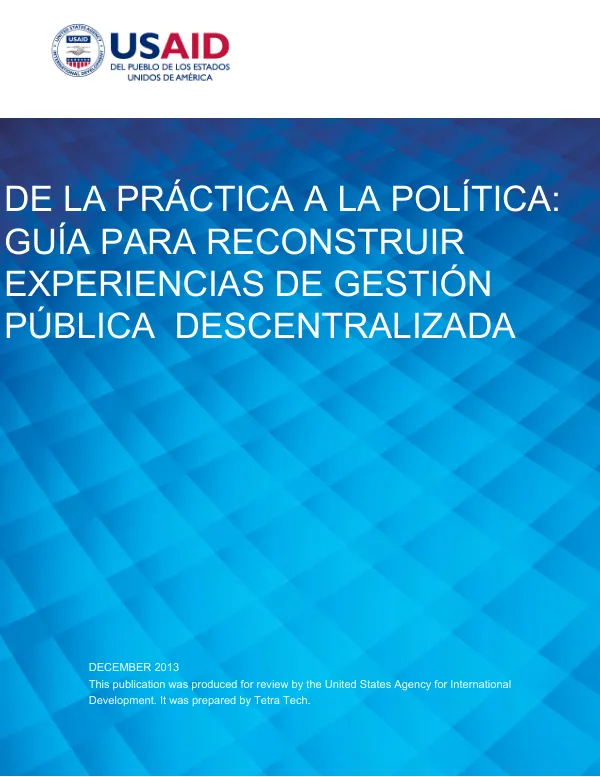
DE LA PRÁCTICA A LA POLÍTICA: GUÍA PARA RECONSTRUIR EXPERIENCIAS DE GESTIÓN PÚBLICA DESCENTRALIZADA
Sign inTETRA TECH
DE LA PRÁCTICA A LA POLÍTICA: GUÍA PARA RECONSTRUIR EXPERIENCIAS DE GESTIÓN PÚBLICA DESCENTRALIZADA
The Programa ProDescentralización de USAID has the objective of contributing to the improvement of decentralized management for the provision of effective services to traditionally excluded populations in the departments of the Amazon.
2013 · 27 pages
Sign in to readA free account is required to download.
Abstract
The program develops actions to improve: (i) the National Policy, (ii) the Institutional Strengthening of Regional and Local Governments, and (iii) Transparency and Accountability to improve participatory management mechanisms. The publication "DE LA PRÁCTICA A LA POLÍTICA: GUÍA PARA RECONSTRUIR EXPERIENCIAS DE GESTIÓN PÚBLICA DESCENTRALIZADA" was produced for review by the United States Agency for International Development by Tetra Tech, through the Peru ProDecentralization Program (Decentralization and Local Governance Program), Contract No. AID-527-C-12-00002. The program focuses on three key interventions: (i) the Policy National, (ii) the Institutional Strengthening of Regional and Local Governments, and (iii) Transparency and Accountability. The program aims to improve the management of decentralized public services, particularly in the departments of the Amazon. The publication presents a guide for reconstructing experiences of decentralized public management, which includes a framework for analyzing and evaluating the effectiveness of decentralized public services. The guide is based on a participatory approach, which involves the active participation of stakeholders, including local governments, civil society organizations, and community leaders. The program has identified several key challenges and opportunities for improving decentralized public management in the departments of the Amazon. These include the need to strengthen institutional capacities, improve transparency and accountability, and enhance the participation of local communities in decision-making processes. The program has developed several tools and methodologies to support the implementation of decentralized public management, including a framework for analyzing and evaluating the effectiveness of decentralized public services, a guide for reconstructing experiences of decentralized public management, and a set of indicators for measuring the impact of decentralized public management. The program has also established a network of stakeholders, including local governments, civil society organizations, and community leaders, to support the implementation of decentralized public management. The network provides a platform for sharing experiences, best practices, and lessons learned, and for coordinating efforts to improve decentralized public management. The program has made significant progress in improving decentralized public management in the departments of the Amazon. The program has strengthened institutional capacities, improved transparency and accountability, and enhanced the participation of local communities in decision-making processes. The program has also developed several tools and methodologies to support the implementation of decentralized public management. The program has identified several key lessons learned and best practices for improving decentralized public management. These include the need to involve local communities in decision-making processes, to strengthen institutional capacities, and to improve transparency and accountability. The program has also emphasized the importance of a participatory approach to decentralized public management, which involves the active participation of stakeholders, including local governments, civil society organizations, and community leaders. The program has also recognized the importance of a comprehensive approach to decentralized public management, which involves addressing the social, economic, and environmental dimensions of decentralized public services. The program has emphasized the need to address the root causes of poverty and inequality, and to promote social inclusion and equity in decentralized public services. The program has also highlighted the importance of a results-based approach to decentralized public management, which involves setting clear goals and objectives, and measuring the impact of decentralized public services. The program has emphasized the need to establish a results-based management system, which involves setting clear indicators and benchmarks for measuring the impact of decentralized public services. The program has also recognized the importance of a collaborative approach to decentralized public management, which involves working with local governments, civil society organizations, and community leaders to improve decentralized public services. The program has emphasized the need to establish partnerships and collaborations to support the implementation of decentralized public management. The program has also identified several key challenges and opportunities for improving decentralized public management in the departments of the Amazon. These include the need to strengthen institutional capacities, improve transparency and accountability, and enhance the participation of local communities in decision-making processes. The program has also emphasized the need to address the root causes of poverty and inequality, and to promote social inclusion and equity in decentralized public services. The program has also recognized the importance of a comprehensive approach to decentralized public management, which involves addressing the social, economic, and environmental dimensions of decentralized public services. The program has emphasized the need to establish a results-based management system, which involves setting clear indicators and benchmarks for measuring the impact of decentralized public services. The program has also identified several key lessons learned and best practices for improving decentralized public management. These include the need to involve local communities in decision-making processes, to strengthen institutional capacities, and to improve transparency and accountability. The program has also emphasized the importance of a participatory approach to decentralized public management, which involves
Related documents
Documents in this collection
 2013
2013USAID DEC
Sistematización del Marco Normativo y Propuestas para Fortalecer la Participación Ciudadana en el Marco del Plan de Acción de Gobierno Abierto y la Política Nacional de Modernización de la Gestión Pública
Open record 2013
2013USAID DEC