NORC AT THE UNIVERSITY OF CHICAGO
Debriefing Research Participant Communities in the Western Highlands of Guatemala
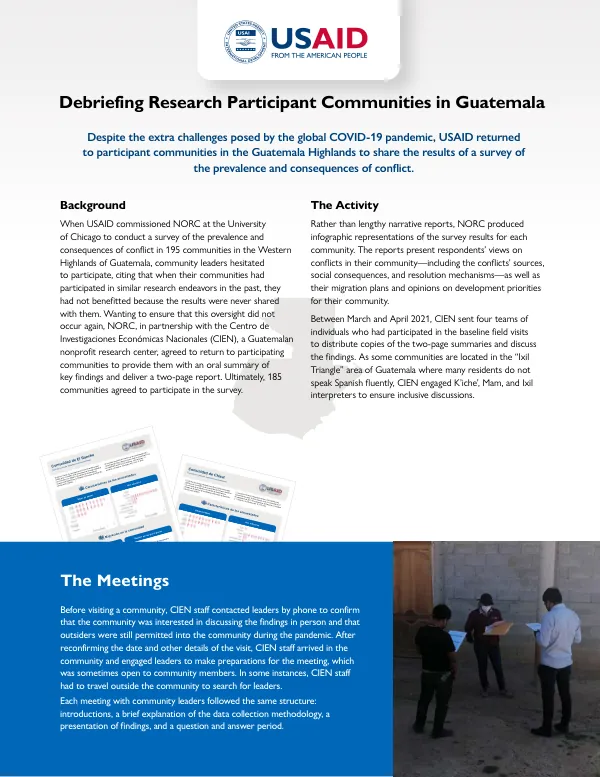
The Western Highlands of Guatemala have been the site of extensive research endeavors, with USAID partnering with NORC at the University of Chicago to conduct a survey of the prevalence and consequences of conflict in 185 communities.
2021 · 2 pages
Sign in to readA free account is required to download.
Abstract
Community leaders expressed hesitation to participate, citing past experiences where results were not shared with them. To address this concern, NORC, in partnership with the Centro de Investigaciones Económicas Nacionales (CIEN), agreed to return to participating communities to share key findings and deliver a two-page report. The survey results were presented in infographic representations for each community, highlighting community members' views on conflicts, including sources, social consequences, and resolution mechanisms, as well as their migration plans and opinions on development priorities. Between April and May 2021, CIEN sent teams to distribute copies of the summaries and discuss findings with community leaders. Interpreters were engaged to facilitate inclusive discussions, as some communities do not speak Spanish fluently. Meetings with community leaders followed a standard format, including introductions, an explanation of the survey methodology, a presentation of findings, and a question-and-answer period. To ensure safety during the COVID-19 pandemic, CIEN implemented strict protocols, including temperature checks, sanitization of chairs and surfaces, and the use of new surgical masks. Meetings were held in well-ventilated areas and limited to eight participants. The survey revealed that COVID-19 slowed the research process, with some participants expressing skepticism about the virus's existence or its impact. Attendees were also hesitant to follow meeting protocols, and outdoor meetings created a less formal environment. Leaders expressed mixed reactions to the findings, with some showing interest in development priorities and others being indifferent. Many leaders expressed a desire for specific projects and requested that USAID be made aware of their community's needs. Leaders also expressed frustration that the meeting did not result in development assistance from USAID. The survey found that many community members had attempted to migrate from their community in the past year, and leaders expressed a desire for USAID to provide support to their community. The most frequently asked question was "What's next?" and what USAID plans to do to help their community.