USAID. MISSION TO THAILAND
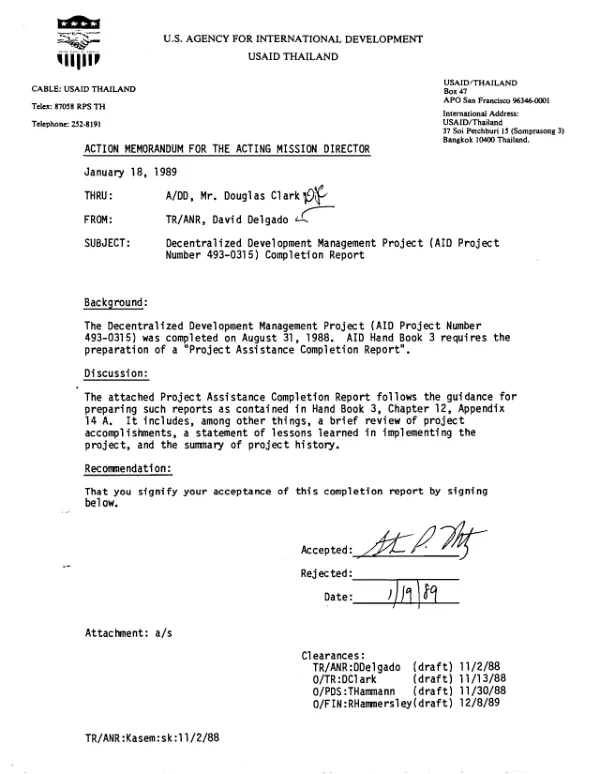
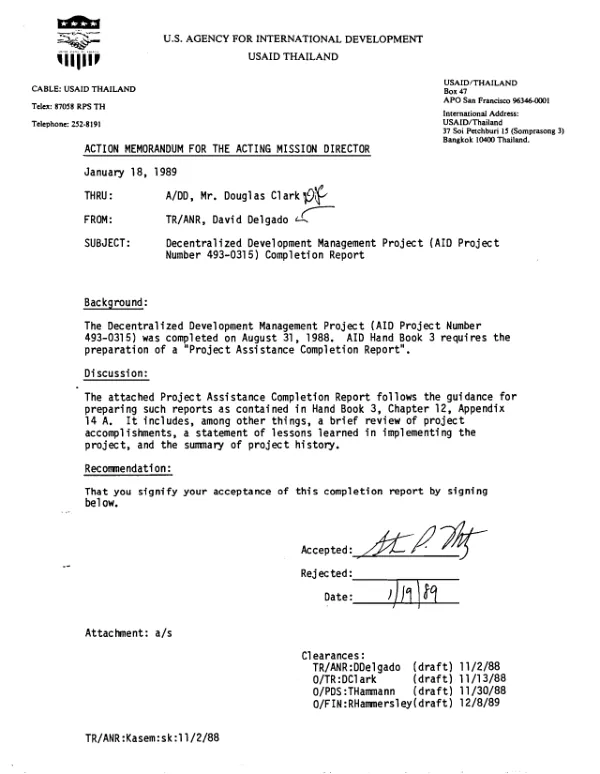
Decentralized development management project (493-0315) : project completion report
PACR of a project (10/82-8/88) to strengthen the capacity of local governments in Thailand to plan, design, and implement rural development projects.
1989
Sign in to readA free account is required to download.
Abstract
The first 5 project years focused on conducting studies of rural development processes in 97 tambons to prepare rural development manuals for replication nationwide. Work progressed in 3 stages. First, the project developed recommendations regarding the Government of Thailand's (GOT's) Rural Employment Generation Program (REGP), which resulted in a series of improvements in subsequent policies and guidelines. The project then prepared and presented to the GOT 60-70 academic papers aimed at promoting decentralized development management and capacity building concepts. Finally, discrete development manuals were designed, using findings from all studies. The last 2 project years were given to testing project-developed manuals on provincial development planning, the tambon financial system, human resources development for rural development, local-level rural development monitoring systems, village development funds, and local maintenance arrangements. Except for the village development funds model, the tests demonstrated that the manuals could be modified for nationwide replication. The most useful manuals were those on planning, resource management, and maintenance. While these models were being tested, REGP budget and A.I.D. loan funds were used to finance small-scale, tambon-level subprojects (SP's) using local natural resources; SP areas included water resource development, access road and bridge construction, economic promotion, and social needs. Over the entire life of the project, some 3,060 such SP's were implemented. Approximately 140 tambons and 140,000 villagers benefited directly from these SP's and a large number of GOT officials at the provincial and district levels participated and learned about rural development processes. The project provided training for approximately 5,000 people at the local level in the fields of planning, engineering, and project implementation. In addition, 18 GOT officials participated in U.S. observation visits and resource management training. Several lessons were learned. (1) The SP's proved to be both a training ground in natural resource management and a source of additional income for villagers. Part of this revenue is returned to the tambon council or village development fund for use in other public projects. (2) The most successful SP's are in tambons with strong local leaders, especially District Officers and their Deputies. (3) The role of the province has been limited to reviewing and approving SP proposals prepared at the tambon and district levels. (4) The Department of Local Administration now has the experience and the authority to institutionalize the most successful elements of the project.
Related documents
Documents in this collection
 1989
1989USAID DEC
Decentralized development management project (493-0315) : project completion report
Open record![End of program evaluation report (Nov 1999-Oct 2002) : cooperative agreement between USAID and WWF [World Wildlife Fund] Indonesia no. 497-A-00-00-00002-00 -- the Outer Islands bioregional program : integrated protected area management and spatial planning in Kalimantan and Papua[, Indonesia]](https://covers.devme.ai/gen/5324.webp) 2002
2002USAID DEC