USAID
Definitions for overseas Operating Units
The Overseas Operating Units of USAID are defined by specific criteria and duties.
2013 · 2 pages
Sign in to readA free account is required to download.
Abstract
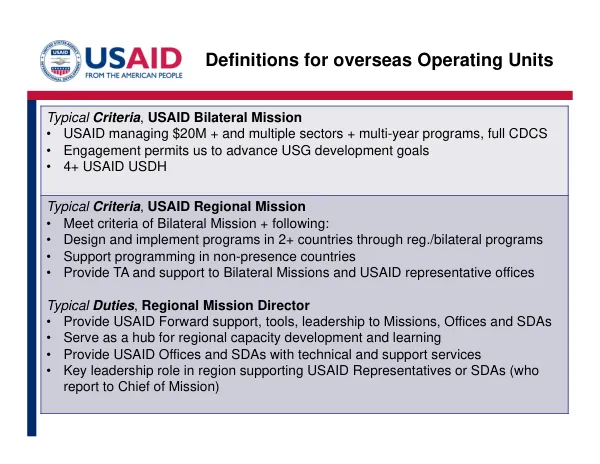
The typical criteria for a USAID Bilateral Mission include managing $20 million or more in funding across multiple sectors and implementing multi-year programs, with a full Country Development Cooperation Strategy (CDCS). This type of mission is established to advance US Government development goals through engagement. A USAID Regional Mission meets the criteria of a Bilateral Mission and also designs and implements programs in two or more countries through regional or bilateral programs. Regional Missions also support programming in non-presence countries and provide technical assistance and support to Bilateral Missions and USAID representative offices. The Regional Mission Director plays a key leadership role in the region, providing USAID Forward support, tools, and leadership to Missions, Offices, and Senior Development Advisors (SDAs). The Director serves as a hub for regional capacity development and learning, providing technical and support services to USAID Offices and SDAs. In countries without a USAID Bilateral Mission but with limited programs, an Office of the USAID Representative is established. This office is led by a Development Counselor to the Chief of Mission and receives Agency policy direction and support from the Regional Assistant Administrator (AA) or Regional Mission, depending on the circumstances. The Office of the USAID Representative does not prepare a full CDCS and has resident staff only where justified. The USAID Representative serves as the post lead for development cooperation, leading or participating in development dialogues at all levels with stakeholders. The Representative closely coordinates with the Regional Mission to identify technical, programmatic, and other support needs and could be designated as a Senior Mission Director (SMG), depending on the determination by the Regional AA and the Office of Human Resources (OHR) in consultation with the Administrator. A Senior Development Advisor (SDA) is posted in countries hosting multilateral donor organizations, newly emerging bilateral donors, or countries with overseas Department of Defense Combat Commands. SDAs receive policy direction from USAID/W bureaus or regional missions and are typically posted in limited presence countries with modest assistance and only one USAID Development Advisor (USDH). The typical duties of an SDA include serving as a Development Counselor to the Chief of Mission or Combatant Commander, building partnerships with other US Government or stakeholders, coordinating the implementation of USAID investments, and directly advising host country government-financed programs. SDAs could be either SMG or non-SMG, depending on the determination of the AA and OHR in consultation with the Administrator. In some cases, USAID has development programs implemented by Private Sector Contractors (PSCs) or Foreign Service Nationals (FSNs) based in-country or from Regional or USAID/W platforms. This type of programming is referred to as non-direct hire programming.
Related documents