USAID DEC
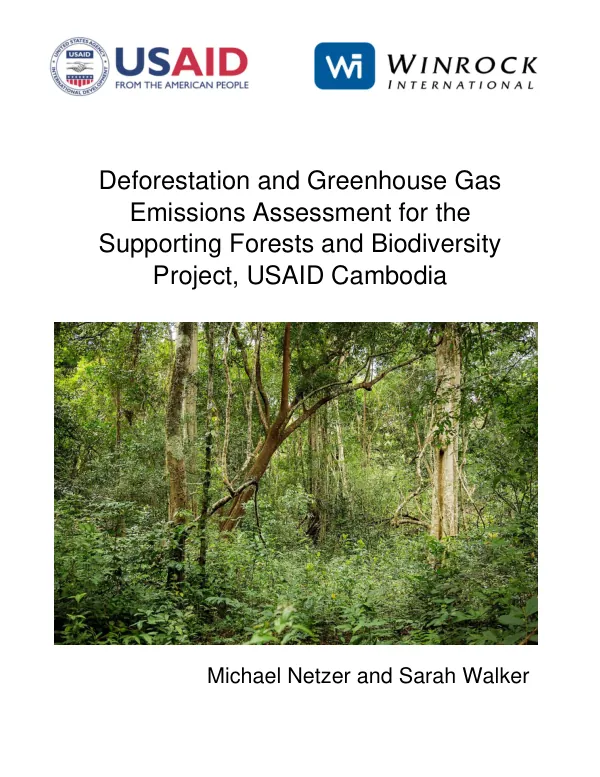
Deforestation and Greenhouse Gas Emissions Assessment for the Supporting Forests and Biodiversity Project, USAID Cambodia
Sign inUSAID
Deforestation and Greenhouse Gas Emissions Assessment for the Supporting Forests and Biodiversity Project, USAID Cambodia
The Supporting Forests and Biodiversity Project in Cambodia aimed to quantify deforestation and greenhouse gas emissions in priority landscapes.
2014 · 34 pages
Sign in to readA free account is required to download.
Abstract
The project used the Hansen et al. (2013) global dataset to assess baseline rates of deforestation. The dataset provided spatially explicit layers for forest cover and deforestation from 2000 to 2012 at a resolution of 30x30m for the entire globe. The baseline rates of deforestation were determined for the Eastern Plains Landscape (EPL) and Prey Long Landscape (PLL). The results showed that over the period from 2000 to 2012, historical deforestation in the EPL and PLL was 0.32% and 0.78% respectively. This equates to an average annual deforestation of 2,605ha y-1 for the EPL and 6,994ha y-1 for PLL. The annual rate of deforestation during this same period in the EPL Reference Region was 2.54% and 2.74% for PLL Reference Region. This equates to a baseline annual deforestation of 6,478ha y-1 for the EPL and 12,421ha y-1 for the PLL. The baseline deforestation rates for the EPL and PLL were set at 2.54% for the EPL and 2.74% per year for PLL. These rates are set for all SFB community forest areas and protected forest areas. The results for baseline deforestation (G1 indicator) are only intended for EPL. The EPL rate of deforestation was projected to be 2.54% (6,478ha-1 y-1). SFB's target is to reduce this deforestation rate by 15% over the life of the project. The Seima REDD Project was validated under the Verified Carbon Standard (VCS) in December of 2014. The project used the deforestation and emission estimates reported directly from the Seima REDD Project Document that has been published and approved by the VCS. The SFB project has set a GHG reduction target of 250,000 t CO2e. The results for GHG emissions showed that the Seima REDD Project avoided deforestation and GHG emissions, with a cumulative GHG emission of 15,253,648 t CO2e from 2013 to 2016.
Related documents