ECODIT, INC.
USAID Cambodia Green Future Activity Stakeholder Map Report
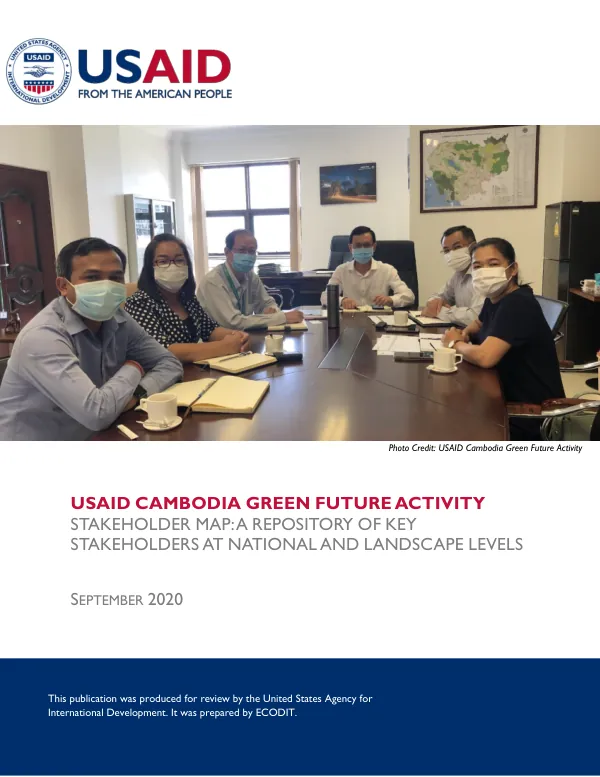
The USAID Cambodia Green Future Activity Stakeholder Map is a repository of key stakeholders at national and landscape levels.
2020 · 55 pages
Sign in to readA free account is required to download.
Abstract
The document was prepared by ECODIT, LLC, under the USAID Contract No. 72044219C00005, and was submitted to USAID on August 11, 2020. The stakeholder map aims to identify and engage key stakeholder groups and individuals in the co-design and co-implementation of a vision, goal, and strategy for sustainable biodiversity conservation in Cambodia. The stakeholder map was developed through a series of methodologies, including key informant interviews, focus group discussions, and literature reviews. The findings of the stakeholder mapping exercise are presented in the document, which highlights the key stakeholder groups and individuals involved in biodiversity conservation in Cambodia. The document identifies several key stakeholder groups, including government agencies, non-governmental organizations (NGOs), civil society organizations, and private sector companies. The government agencies include the Ministry of Environment, the Ministry of Information, and the Ministry of Education, Youth and Sport. The NGOs include the Wildlife Conservation Society, the World Wildlife Fund Cambodia, and the Population Service International Cambodia. The stakeholder map also highlights the importance of communication tools, materials, approaches, and messages in biodiversity conservation. The document notes that traditional media, such as TV, radio, and print materials, are still widely used in Cambodia, but social media platforms, such as Facebook and Instagram, are becoming increasingly popular. The document identifies several overlaps, gaps, and opportunities for collaboration among stakeholder groups. The overlaps include the shared goals and objectives of stakeholder groups, such as biodiversity conservation and sustainable development. The gaps include the lack of coordination and collaboration among stakeholder groups, which can lead to duplication of efforts and inefficient use of resources. The opportunities for collaboration include the potential for stakeholder groups to work together to achieve common goals and objectives. The document concludes by highlighting the importance of stakeholder engagement and collaboration in biodiversity conservation. The recommendations include the need for stakeholder groups to work together to develop a shared vision, goal, and strategy for sustainable biodiversity conservation in Cambodia. The stakeholder map is a valuable tool for understanding the complex stakeholder landscape in Cambodia and identifying opportunities for collaboration and engagement. The document provides a comprehensive overview of the key stakeholder groups and individuals involved in biodiversity conservation in Cambodia and highlights the importance of communication tools, materials, approaches, and messages in achieving sustainable biodiversity conservation. The document also highlights the importance of addressing the gaps and overlaps identified in the stakeholder map. The gaps include the lack of coordination and collaboration among stakeholder groups, which can lead to duplication of efforts and inefficient use of resources. The overlaps include the shared goals and objectives of stakeholder groups, such as biodiversity conservation and sustainable development. The document provides a comprehensive overview of the stakeholder map and highlights the importance of stakeholder engagement and collaboration in biodiversity conservation. The recommendations include the need for stakeholder groups to work together to develop a shared vision, goal, and strategy for sustainable biodiversity conservation in Cambodia.
Related documents