UNIVERSITY OF OXFORD
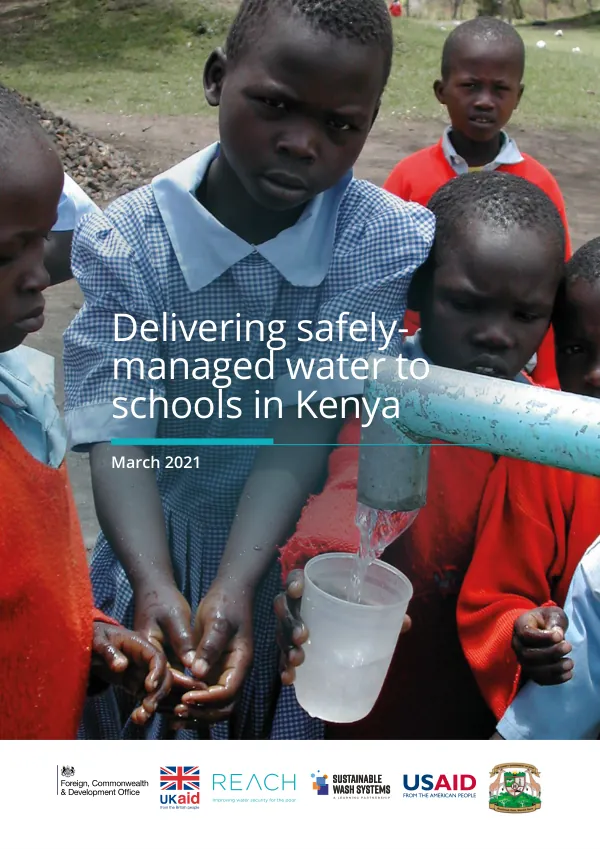
Delivering safely-managed water to schools in Kenya
In Kenya, delivering safely-managed water to schools is critical for the current welfare and future development of 20 million children attending 37,910 primary and 11,399 secondary schools.
2021 · 56 pages
Sign in to readA free account is required to download.
Abstract
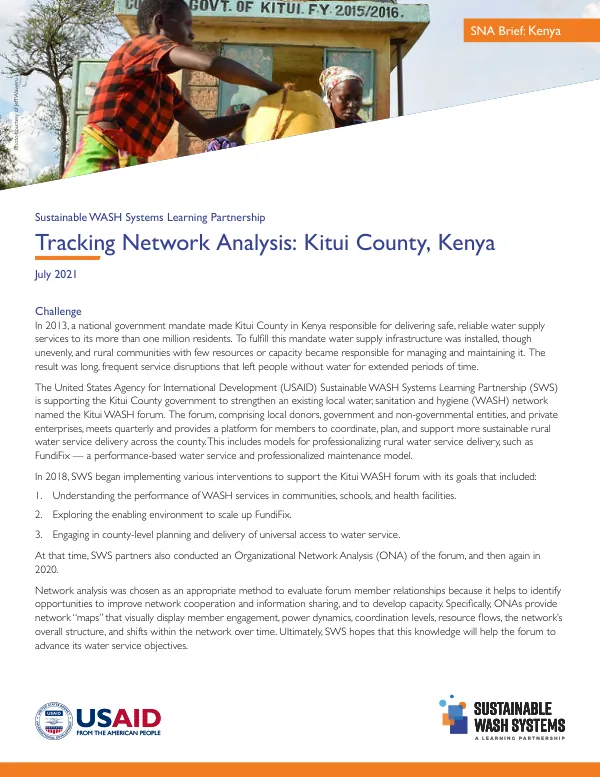
Without safe water in schools for drinking, food preparation, handwashing, and general hygiene and sanitation, even basic education outcomes will prove difficult to achieve and sustain. The COVID-19 pandemic has increased understanding of the critical role of water services in schools for health, gender equality, and social development. The report presents the status of school water, sanitation, and hygiene (WASH) services in Kitui County, drawing upon a survey of 1,887 primary and secondary schools in 2019. The evaluation of water resource risks in the county reveals how climate anomalies affect rainwater harvesting for schools and the influence of geology on groundwater quality. The report also considers policy responses to guide new thinking on the delivery of safely-managed water services, informed by the performance of a professional maintenance service provider guaranteeing rapid repairs to handpumps and small piped systems within days, and monthly monitoring of water quality. Kenya's national education strategy predicted a USD 6.66 billion deficit for 2018 to 2022, without including the cost of delivering safely-managed WASH services in schools. National budget allocations are both insufficient and inefficiently allocated. Despite the legal, financial, and service delivery challenges for safely-managed WASH services in schools in rural Kenya, there is evidence that services can be improved and sustained. The report identifies four conditions to improve outcomes: clarifying national and county responsibilities for WASH services in schools, improving monitoring and regulatory capacity at the county level, using information from monitoring systems to rethink funding models, and piloting performance-based models to support a national program of reform. Kitui County is uniquely placed to scale up the results and lessons of a professional model for safely-managed WASH services in schools, providing a basis to plan for and execute a performance-based service delivery model for all schools in the county. The approach could be adapted to all counties in Kenya, making safely-managed water in schools feasible but dependent on exceptional political leadership and ministerial cooperation to agree and execute a shared vision. The safety, reliability, and sufficiency of drinking water, sanitation, and hygiene have a significant impact on the development of children and their learning. Faecal contamination of drinking water can result in diarrheal diseases that reduce children's time in school, while chemical contaminants can affect children's development over longer timeframes. Long-term exposure to either faecal or chemical contamination can permanently reduce children's cognitive abilities. Safely-managed services will be essential to sustain the health, development, and learning benefits of safe drinking water, adequate sanitation, and effective hygiene facilities. Globally, the number of children without basic WASH services at school is 584 million for water, 698 million for sanitation, and 818 million for hygiene services. Africa has millions more children without access to these services in school, with categories of basic, limited, and no services defined in Figure 2. The criteria of 'safely-managed' WASH services is qualitatively higher and more onerous, with wider financial and institutional challenges.
Related documents