USAID DEC
Sustainable WASH Systems Learning Partnership: Tracking Network Analysis: Kitui County, Kenya
Sign inENVIRONMENTAL INCENTIVES, LLC
Sustainable WASH Systems Learning Partnership: Tracking Network Analysis: Kitui County, Kenya
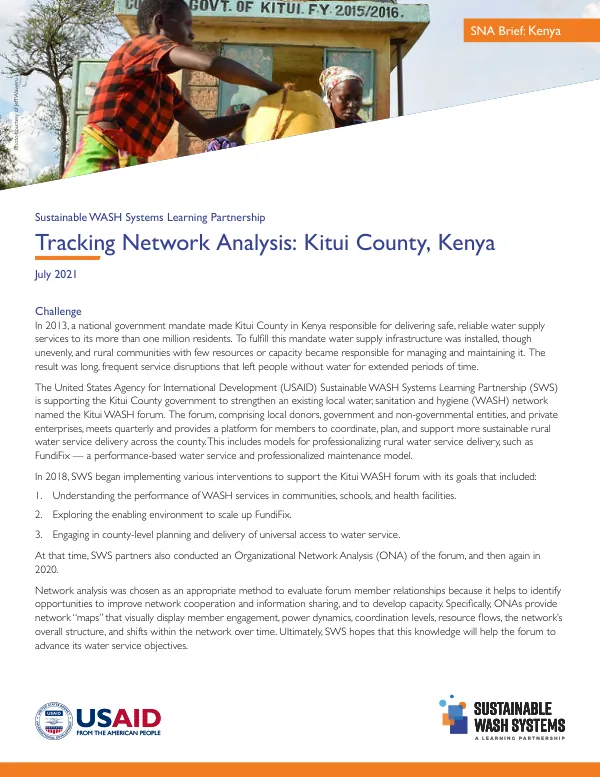
The Kitui WASH forum in Kenya is a local water, sanitation, and hygiene (WASH) network comprising local donors, government entities, non-governmental organizations, and private enterprises.
2021 · 3 pages
Sign in to readA free account is required to download.
Abstract
The forum's primary objective is to coordinate, plan, and support more sustainable rural water service delivery across Kitui County. The United States Agency for International Development (USAID) Sustainable WASH Systems Learning Partnership (SWS) is supporting the Kitui County government to strengthen the forum. In 2018, SWS began implementing various interventions to support the Kitui WASH forum, including understanding the performance of WASH services in communities, schools, and health facilities, exploring the enabling environment to scale up the FundiFix performance-based water service and professionalized maintenance model, and engaging in county-level planning and delivery of universal access to water service. SWS partners also conducted an Organizational Network Analysis (ONA) of the forum in 2018 and again in 2020. The ONA was chosen as an appropriate method to evaluate forum member relationships because it helps to identify opportunities to improve network cooperation and information sharing, and to develop capacity. The ONA provides network "maps" that visually display member engagement, power dynamics, coordination levels, resource flows, the network's overall structure, and shifts within the network over time. The 2020 ONA and its comparison to the 2018 study helped SWS partners answer questions about how the network has changed over the past two years, to what extent different stakeholder groups have become stronger or more influential, and to what extent actors are coordinating or interacting more. SWS interviewed 29 key Kitui WASH actors, all forum members, selected for their authority, knowledge, and consistent involvement in the local sector. Questions centered around quantifying four relationship types: information-sharing, skill-sharing, resources, and authority. Other qualitative-focused questions were asked to gather information on successes, challenges, and suggested solutions toward sustainable water service and maintenance in Kitui. Partners gathered 15 of the interviewees to discuss and explain preliminary ONA findings, incorporating feedback from participants into the final report. A comparison between the baseline 2018 ONA and the 2020 endline ONA shows an overall increase of network actor relationships in terms of types and frequencies of interaction. The endline Kitui ONA displays one large cluster with no isolated clusters to limit relationships. The combined number of all measured relationship tie types increased fourfold between 2018 and 2020, from 223 at baseline to 825 at endline. Information exchange saw the biggest relationship growth from 117 to 345. The endline ONA also indicates that the county government dominates two critical relationship types — skills transfer and influence — previously occupied by NGOs in Kitui. The county government expanded its role as a central skill provider and recipient, interacting with the entire network in terms of consultations, training, coaching, and co-developing solutions. The endline ONA shows significant relationship and interaction growth among Kitui WASH network actors, driven largely by the forum's quarterly meetings and follow-up activities. Interviewees revealed that the forum's collective approach to planning, monitoring, and reporting county WASH performance served to both increase and strengthen network relationships, and led to the emergence of sub-county WASH forums at the local levels. WASH actors say they anticipate a continued strong WASH network to lead to increased private sector participation and the scaling up of professionalized models for rural water service delivery across the country for more reliable water services.