USAID DEC
Designing interoperable health information systems using Enterprise Architecture approach in resource-limited countries: A literature review
Sign inJOHN SNOW INTERNATIONAL
Designing interoperable health information systems using Enterprise Architecture approach in resource-limited countries: A literature review
Enterprise Architecture (EA) is a comprehensive approach to integrating business and technical processes in health information systems (HIS).
2019 · 15 pages
Sign in to readA free account is required to download.
Abstract
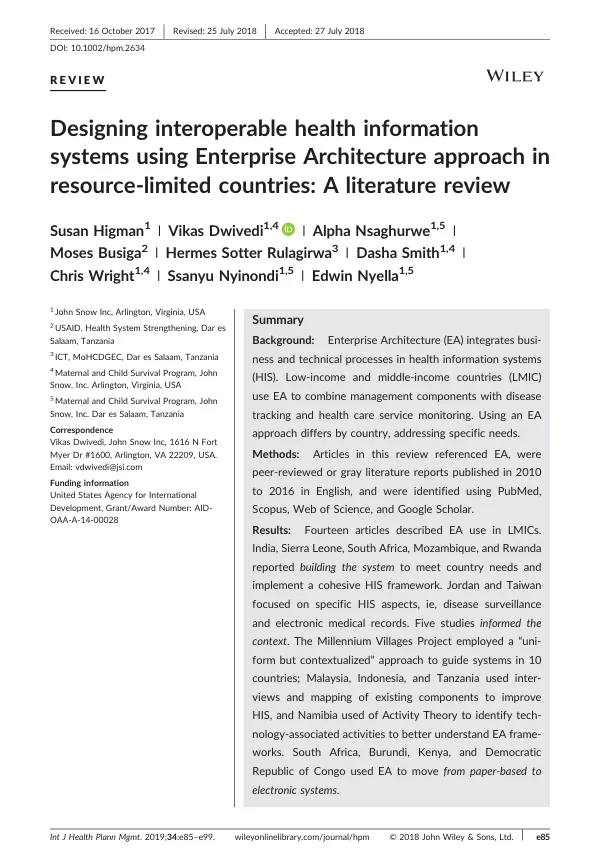
Low-income and middle-income countries (LMICs) use EA to combine management components with disease tracking and health care service monitoring. EA differs by country, addressing specific needs and priorities. The World Health Organization (WHO) prioritizes achieving health and well-being, coordinating service delivery, and strengthening governance and accountability. Underpinning these priorities is the need for a reliable HIS that combines national health priorities with local requirements. WHO identified HIS as one of the six health system building blocks, though data are essential to each of the other five health system components: service delivery, health workforce, access to essential medicines, financing, and leadership/governance. A comprehensive architecture can facilitate communication between building blocks and promote interoperability across existing components, harmonizing the country's overall strategy to include new skills, tools, and holistic systems in a manageable and sustainable manner. EA offers a framework or blueprint to identify the business processes, data, and technical or technological processes for the development of an integrated HIS. Although application of EA can include adapting tools or templates available from open source software, commercial products, or certification programs, this manuscript will focus on the processes and essential artifacts that are common across its implementation. For many LMICs, incomplete data and cumbersome systems are the byproduct of vertical and fragmented health programming, health sector reforms, nonaligned funding, and unsynchronized reporting requirements. Incompatible data collection methods, standards, and protocols limit the integration of HIS components. Initiatives like the Population Health Implementation and Training Partnerships, established in five sub-Saharan African countries, promote an iterative and tailored approach to strengthening health systems that focuses on existing tools, multiple data sources, theories of change, and HIS linkages to improve decision-making. Interoperability ensures that data can be readily exchanged and disseminated at multiple levels. Yet, the roll-up of data from health facilities to districts to national agencies may reveal incomplete or inaccurate data, identify areas where lack of training and time for data collection impact results, and indicate gaps between multiple platforms, such as District Health Information Software (DHIS), Open MRS, and locally adapted information platforms. EA's comprehensive approach to specific country adaptations and changes over time builds on a cross-sector portfolio of practices and methods applied to shared data elements, business processes, governance mechanisms, and investment strategies. The incorporation of business/financial applications with ICT infrastructure helps countries manage diverse health sector operations and resources. EA is applied through multiple frameworks, such as The Open Group Architecture Framework (TOGAF), Zachman framework, Enterprise Architecture Planning, Generalized Enterprise Reference Architecture and Methodology, and Extended Enterprise Architecture framework, that vary parameters to meet country or corporate needs. The literature review identified 14 articles that described EA use in LMICs. India, Sierra Leone, South Africa, Mozambique, and Rwanda reported building the system to meet country needs and implement a cohesive HIS framework. Jordan and Taiwan focused on specific HIS aspects, such as disease surveillance and electronic medical records. Five studies informed the context, including the Millennium Villages Project, which employed a "uniform but contextualized" approach to guide systems in 10 countries. Four themes emerged from the literature review: the importance of multiple sectors and data sources, the need for interoperability, the ability to incorporate system flexibility, and the desirability of open group models, data standards, and software. These themes mapped to EA frameworks and operational components and to health system building blocks and goals. Most articles focused on processes rather than outcomes, as countries are engaged in implementation.
Related documents