HEALTH ALLIANCE INTERNATIONAL
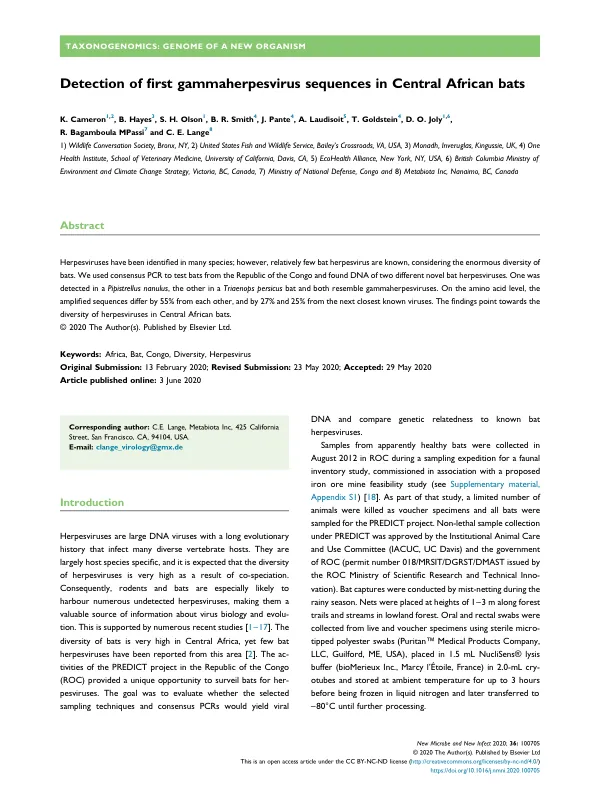
Detection of first gammaherpesvirus sequences in Central African bats
Herpesviruses have been identified in numerous species, but relatively few bat herpesviruses are known, considering the vast diversity of bats.
2020 · 4 pages
Sign in to readA free account is required to download.
Abstract
A study conducted in the Republic of the Congo used consensus PCR to test bats from the region and found DNA of two different novel bat herpesviruses. One was detected in a Pipistrellus nanulus, the other in a Triaenops persicus bat, and both resemble gammaherpesviruses. The amplified sequences differ by 55% from each other and by 27% and 25% from the next closest known viruses. The study used a combination of oral and rectal swabs from live and voucher specimens to collect samples. The swabs were placed in lysis buffer and stored at ambient temperature for up to 3 hours before being frozen in liquid nitrogen and later transferred to -80°C until further processing. DNA was manually extracted using Trizol and stored at -80°C until analysis. Samples were tested with two nested consensus PCR assays, one targeting an approximately 374-nucleotide fragment of the DNA packaging terminase subunit 1 gene and the other targeting an approximately 175-nucleotide fragment of the conserved catalytic subunit of the DNA polymerase gene. Phylogenetic analysis revealed that the two novel sequences clustered with gammaherpesviruses, in two separate branches with other bat herpesvirus sequences. The sequences showed 70% and 64% similarity to known herpesvirus sequences on the nucleotide level and 75% and 73% identity on the amino acid level. The study's findings suggest that a high herpesvirus diversity in Central African bat species can be expected, considering the diversity of bats in the region and the number of bat herpesviruses detected elsewhere. The study's results are consistent with previous findings that have reported herpesvirus DNA prevalence up to 45% in oral samples of bats. The combination of oral swab sampling and consensus DPOL PCR appears to be a promising first step in further investigating bat herpesvirus prevalence and diversity. The study's findings also highlight the need for further research on the biology and evolution of bat herpesviruses, including larger numbers of diverse bat hosts and next-generation sequencing techniques. The study's results have implications for our understanding of the diversity of herpesviruses in Central African bats. The detection of two novel gammaherpesviruses in the Congo Basin marks the first detection of gammaherpesviruses from this region, where only two bat alphaherpesviruses have been described previously. The study's findings support the hypothesis that a high herpesvirus diversity in Central African bat species can be expected, and highlight the need for further research on the biology and evolution of bat herpesviruses.
Related documents
Documents in this collection
 2014
2014USAID DEC
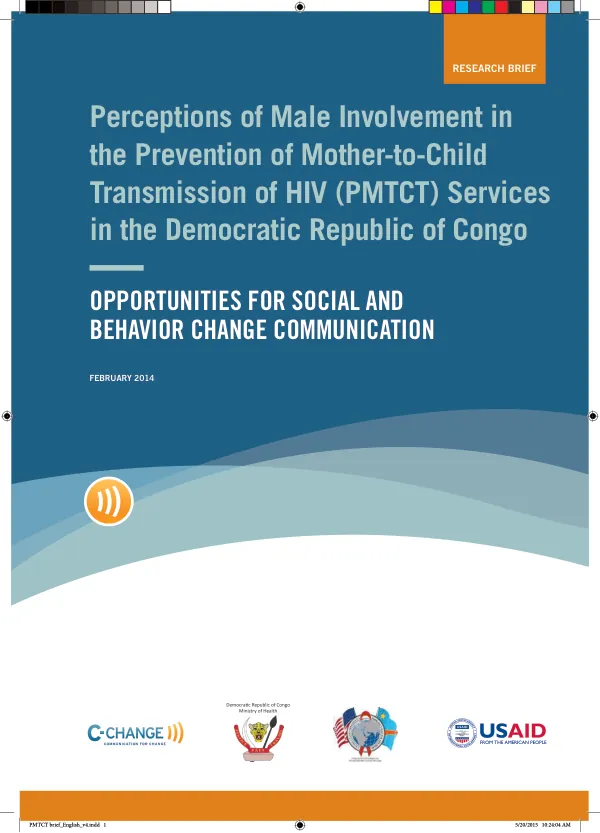
Perceptions of Male Involvement in the Prevention of Mother-to-Child Transmission of HIV (PMTCT) Services in the Democratic Republic of Congo: Opportunities for Social and Behavior Change Communication
Open record 2023
2023USAID DEC