JOHNS HOPKINS UNIVERSITY BLOOMBERG SCHOOL OF PUBLIC HEALTH/INFO PROJECT
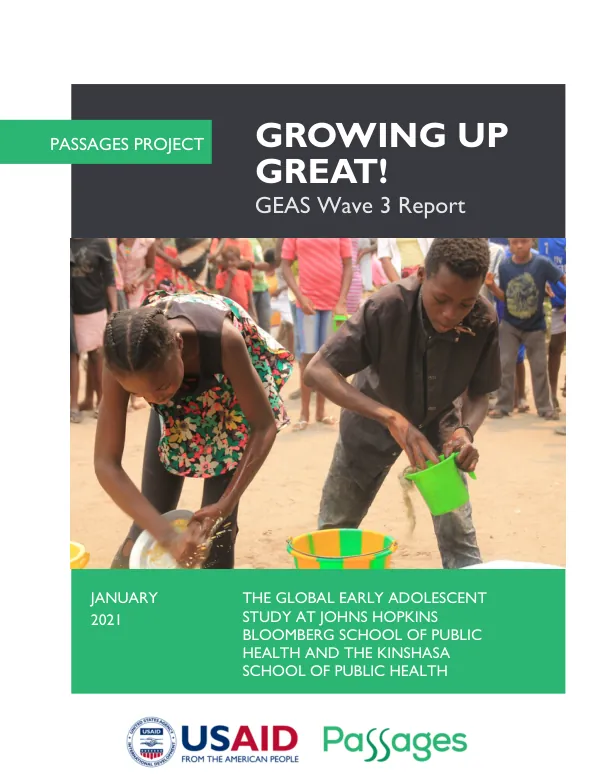
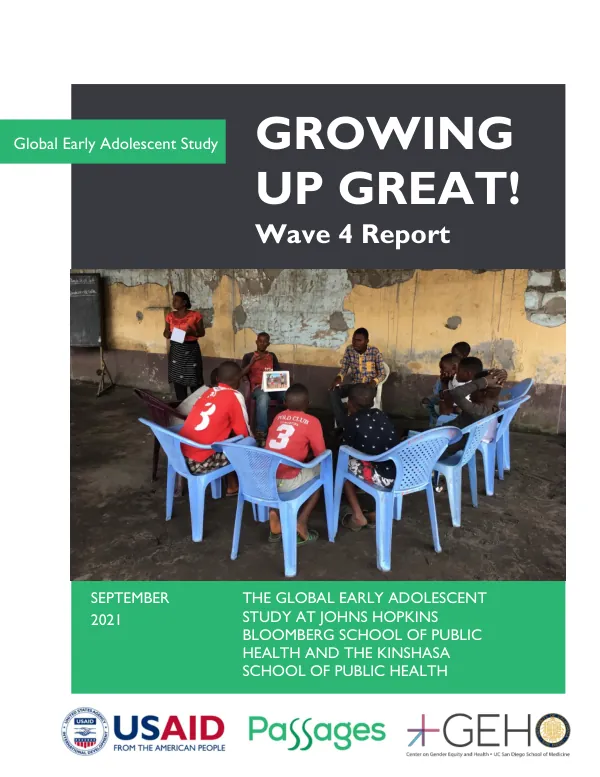
Growing UP Great! Global Early Adolescent Study Wave 4 Report
The Global Early Adolescent Study (GEAS) Growing Up Great!
2021 · 79 pages
Sign in to readA free account is required to download.
Abstract
Wave 4 Report was prepared by a team of researchers from Johns Hopkins Bloomberg School of Public Health, Kinshasa School of Public Health, and the University of California San Diego. The report presents findings from the GEAS study, which is funded by the Bill & Melinda Gates Foundation and the United States Agency for International Development (USAID). The GEAS study is a longitudinal study that aims to understand the experiences of early adolescents in Kinshasa, Democratic Republic of Congo. The study focuses on the Growing Up Great! (GUG) intervention, which is a comprehensive program designed to promote the health, well-being, and education of early adolescents. The GUG intervention includes activities for very young adolescents, parents and caregivers, school-based activities, and community-based activities. The Wave 4 report presents evaluation results from the GUG intervention, which were collected from a sample of 1,500 early adolescents in Kinshasa. The report includes findings on the socio-demographic characteristics of the study population, as well as comparisons between the intervention and control groups at baseline and Wave 4. The report presents findings on several key outcomes, including sexual and reproductive health knowledge, attitudes, and behaviors; assets and agency; and gender-equitable attitudes and norms. The results show that the GUG intervention had a positive impact on the study population, with significant improvements in sexual and reproductive health knowledge, attitudes, and behaviors, as well as increases in assets and agency. The report also presents findings on gender-equitable attitudes and norms, including perceptions of gender norms, attitudes related to gender and sex, and sharing of chores. The results show that the GUG intervention had a positive impact on these outcomes, with significant improvements in gender-equitable attitudes and behaviors. The report highlights the importance of the GUG intervention in promoting the health, well-being, and education of early adolescents in Kinshasa. The findings suggest that the intervention is effective in promoting positive outcomes, including improved sexual and reproductive health knowledge, attitudes, and behaviors, as well as increases in assets and agency. The GEAS study and the GUG intervention provide valuable insights into the experiences of early adolescents in Kinshasa and the effectiveness of comprehensive programs in promoting their health, well-being, and education. The findings of this report have important implications for policymakers, program implementers, and researchers working to improve the lives of early adolescents in low- and middle-income countries. The report concludes by highlighting the need for continued investment in comprehensive programs like the GUG intervention, which have been shown to be effective in promoting positive outcomes for early adolescents. The findings of this report provide a strong case for the importance of investing in the health, well-being, and education of early adolescents, and for the need to continue to support and scale up comprehensive programs like the GUG intervention. The report includes several appendices, which provide additional information on the study population, data collection procedures, and evaluation results. The appendices include a flow chart of the study population across the four waves of data collection, a loss to follow-up analysis, and per protocol analysis of out-of-school and in-school adolescents. Overall, the Global Early Adolescent Study Growing Up Great! Wave 4 Report presents a comprehensive and rigorous evaluation of the GUG intervention, which has been shown to be effective in promoting positive outcomes for early adolescents in Kinshasa. The findings of this report have important implications for policymakers, program implementers, and researchers working to improve the lives of early adolescents in low- and middle-income countries.
Related documents