USAID DEC
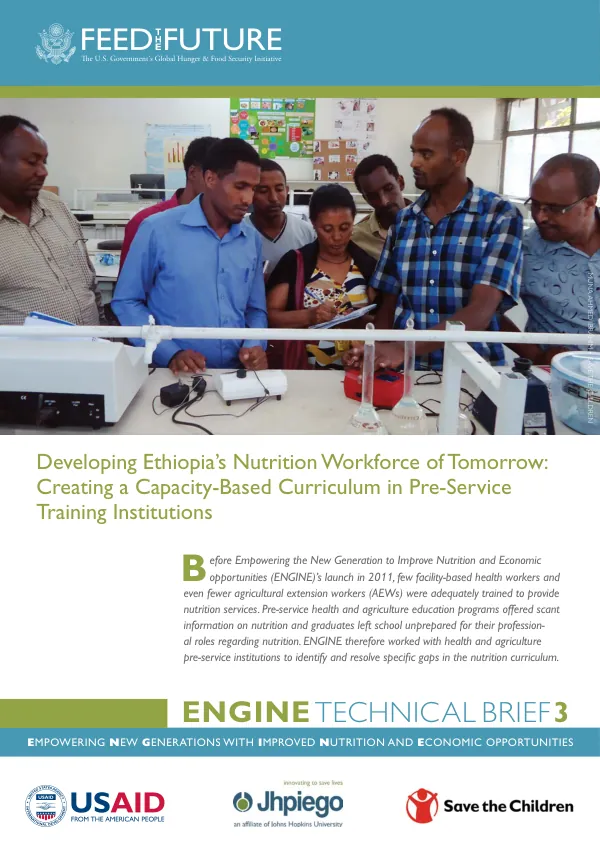
Developing Ethiopia’s Nutrition Workforce of Tomorrow: Creating a Capacity-Based Curriculum in Pre-Service Training Institutions
Sign inJHPIEGO
Developing Ethiopia’s Nutrition Workforce of Tomorrow: Creating a Capacity-Based Curriculum in Pre-Service Training Institutions
In Ethiopia, the ENGINE project aimed to develop a capacity-based curriculum in pre-service training institutions to improve nutrition education.
2016 · 4 pages
Sign in to readA free account is required to download.
Abstract
Before the project's launch in 2011, few facility-based health workers and even fewer agricultural extension workers (AEWs) were adequately trained to provide nutrition services. Pre-service health and agriculture education programs offered scant information on nutrition, leaving graduates unprepared for their professional roles regarding nutrition. ENGINE worked with health and agriculture pre-service institutions to identify and resolve specific gaps in the nutrition curriculum. An assessment of the nutrition curriculum in 12 pre-service institutions identified a lack of skills-based content as the most pertinent gap to be addressed. The schools offered no instruction on practical skills such as counseling, use of anthropometric materials, and techniques for cooking diversified foods. Nutrition labs were also lacking, and the schools provided no information on Ethiopia's nutrition programs. ENGINE interviewed staff at the regional and woreda-level health and agriculture ministries, frontline health workers, AEWs, and Ministry of Education staff to identify the skills these professionals routinely used in the provision of nutrition services. With this information, the project developed a list of nutrition core competencies for health workers (subdivided by specialty) and another for agriculture workers. The project worked with the institutions and instructors to incorporate the competencies into 98 nutrition courses in 14 institutions, ensuring that the courses teach the skills graduates would need to provide nutrition services in Ethiopia. The agricultural training centers added nutrition content to existing courses, but the information was not included in the final Center of Competency exam. To require students to master the nutrition skills, the nutrition competencies would either have to be taught in stand-alone courses or included in the official graduation requirements for ATVET schools. ENGINE and the educational institutions successfully advocated with the Ministry of Education and Ministry of Agriculture to require the incorporation of the nutrition core competencies into the existing coursework and graduation requirements in all ATVET and agricultural universities in Ethiopia. ENGINE supported 369 educators to self-identify gaps in five key aspects of education, analyze the causes of the gaps, and create and implement an action plan aimed at strengthening their work. The main challenges the instructors identified were weak pedagogic skills, insufficient nutrition content in curriculum, insufficient assessment of courses, nonexistent or poorly equipped nutrition labs, and absent or dysfunctional quality assurance systems. ENGINE held workshops for the instructors to address these gaps and provided materials such as reference books and papers, guidelines, anthropometric equipment, scales, calipers, and cooking demonstration sets to equip nutrition skills laboratories. The 14 universities' achievement of the nutrition education performance standards improved 62 percent between April 2012 and May 2014. Some of the specific changes included improved classroom instruction, increased practical instruction, and institutions developing more rigorous approaches to assess the effectiveness of their courses. Nutrition forums were also integrated into the curriculum for entering students, but did not change the course of study in the upper levels. To ensure graduating students were familiar with the nutrition core competencies and existing nutrition programs in Ethiopia, ENGINE organized nutrition forums each year, introducing the National Nutrition Program and National Nutrition Strategy, nutrition-sensitive agriculture, and the basic roles graduates might play in the provision of nutrition services. ENGINE supported the development of an Academic Center of Excellence for Nutrition at Hawassa University College of Agriculture, the first of its kind in Ethiopia. The center was equipped with essential tools for service delivery and research, and students provided state-of-the-art nutrition services under the supervision of qualified instructors and partner with professionals on research focused on Ethiopia's nutrition priorities. ENGINE also provided financial support for 108 master's and 7 doctorate candidates' research on subjects such as nutrition education, micronutrients, breastfeeding and complementary feeding, and food security, health, and nutrition. By equipping students, health extension workers, health clinic staff, AEWs, and their supervisors with competency-based nutrition skills, ENGINE has contributed to the development of a workforce capable of supporting nutrition-sensitive agriculture activities and created a sustainable pipeline of well-trained future professionals. Working within government structures and priorities accelerated progress, as ENGINE's work with the existing structures for pre-service training aligned with the GOE's overall vision for improving Ethiopia's educational institutions. To improve nutrition pre-service education, support must be comprehensive, addressing all identified needs, including training of instructors, establishment of nutrition skill labs, provision of education materials, and implementation of the SBM-R to monitor the quality of education.