FEDERAL MINISTRY OF HEALTH
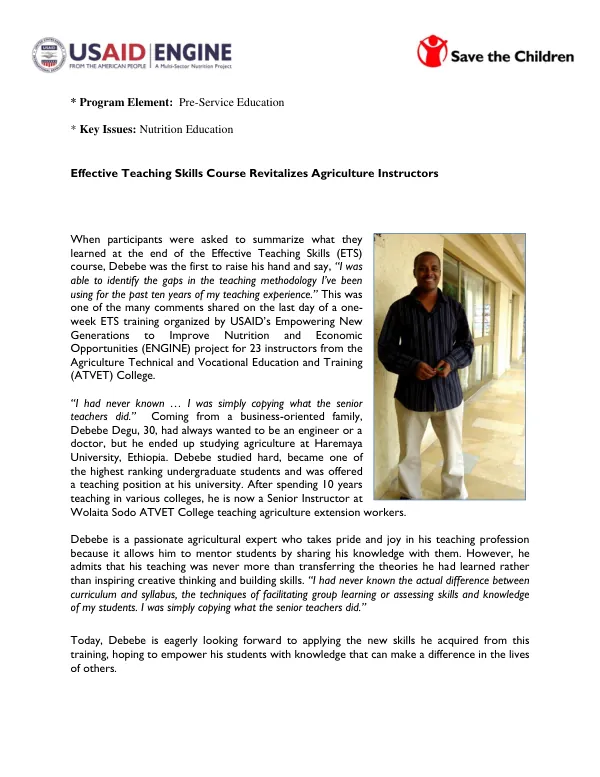
Effective Teaching Skills Course Revitalizes Agriculture Instructors
The Effective Teaching Skills Course Revitalizes Agriculture Instructors is a training program organized by USAID's Empowering New Generations to Improve Nutrition and Economic Opportunities (ENGINE) project.
2016 · 2 pages
Sign in to readA free account is required to download.
Abstract
The course aimed to enhance the teaching skills of 23 instructors from the Agriculture Technical and Vocational Education and Training (ATVET) College. Debebe Degu, a Senior Instructor at Wolaita Sodo ATVET College, was one of the participants who expressed significant improvement in his teaching methodology after completing the course. He acknowledged that he had been simply copying the methods used by senior teachers and had not known the difference between curriculum and syllabus, or the techniques of facilitating group learning and assessing student skills. The ENGINE project is a five-year initiative (2011-2016) that focuses on preventing under-nutrition during the first 1,000 days by promoting social behavior change, including linkages to livelihood and economic opportunities. The project is implemented in 83 productive woredas in four regions of Ethiopia: Amhara, Tigray, SNNPR, and Oromia. ENGINE aims to benefit 3.1 million under-five children, half a million pregnant and lactating women, 3.2 million women of reproductive age, and 2.7 million households. The project is carried out by a consortium of organizations, with Save the Children as the prime implementer in collaboration with the Federal Ministry of Health and Ministry of Agriculture and their decentralized health and agriculture systems. The ENGINE project builds upon the Government of Ethiopia's initiatives and renewed commitment to nutrition, as well as the U.S. Government's Global Health and Feed the Future initiatives. The project works with universities, regional colleges, Feed the Future and health partners, and the Ethiopian Health and Nutrition Research Institute. The project's goal is to enable Ethiopian women and children to lead healthier and more productive lives through sustainable, coordinated, and evidence-based interventions. The ENGINE project's approach to improving nutrition and economic opportunities is multifaceted. It includes training programs for agriculture instructors, such as the Effective Teaching Skills Course, to enhance their teaching skills and knowledge. The project also focuses on social behavior change, including linkages to livelihood and economic opportunities, to prevent under-nutrition during the first 1,000 days. By working with various stakeholders, including government institutions, universities, and health partners, the ENGINE project aims to create a sustainable and coordinated approach to improving nutrition and economic opportunities in Ethiopia. The ENGINE project's impact is expected to be significant, with the potential to benefit millions of people in Ethiopia. The project's focus on preventing under-nutrition during the first 1,000 days is critical, as this period is crucial for a child's development and future health. By promoting social behavior change and linkages to livelihood and economic opportunities, the ENGINE project aims to create a lasting impact on the nutritional status of Ethiopian women and children.
Related documents