USAID
Developing Management Objectives for the Integrated Country Strategy
Management Objectives are a critical component of the Integrated Country Strategy (ICS), serving as a framework for long-term and critical management priorities.
3 pages
Sign in to readA free account is required to download.
Abstract
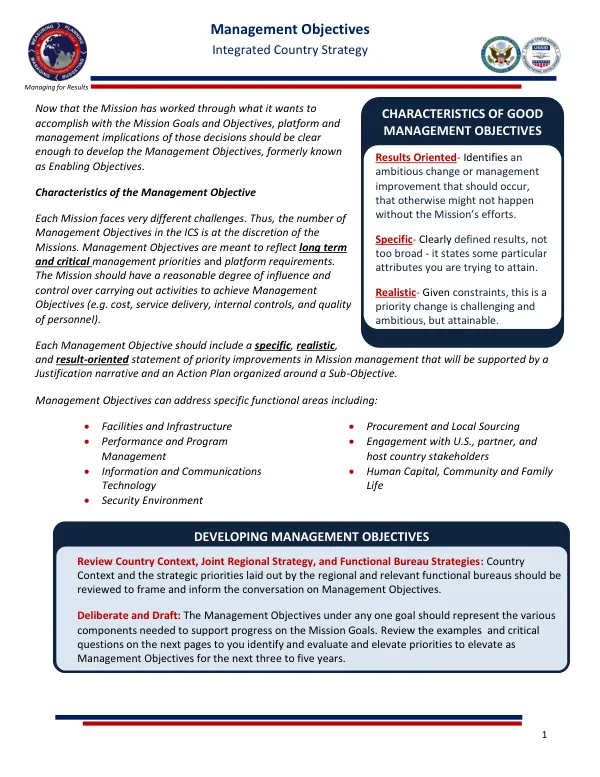
Each Mission has the discretion to determine the number of Management Objectives, which should reflect the unique challenges and requirements of the country context. These objectives are meant to be result-oriented, specific, and realistic, with a clear justification narrative and action plan. The development of Management Objectives involves a deliberate and collaborative process, where the Mission reviews the country context, joint regional strategy, and functional bureau strategies to inform the conversation. The objectives should represent the various components needed to support progress on the Mission Goals, and should be evaluated and prioritized to elevate as Management Objectives for the next three to five years. A properly written Management Objective should have two key components: a desired change or improvement from the current state, and the effort or action that influences or impacts the improvement or change. This is exemplified in the statement: "ICASS customer satisfaction and cost effectiveness is improved through realigned service delivery processes and streamlined functions." In this example, the effort or role is realigning service delivery processes and streamlining functions, and the change or improvement from the current state is improved customer satisfaction and cost effectiveness. Management Objectives can address specific functional areas, including Facilities and Infrastructure, Performance and Program Management, Engagement with U.S., partner, and host country stakeholders, Human Capital, Community and Family Life, Procurement and Local Sourcing, and Information and Communications Technology. For instance, in the area of Facilities and Infrastructure, the Mission should consider how its facilities infrastructure will impact the ability to implement action plans, and how it will implement greening and sustainability improvements in the next three to five years. In the area of Security Environment, the Mission should assess whether the security environment will affect the capability to engage host government counterparts to implement activities in ICS Objective action plans. The Mission should also consider what actions it will take to address threats to enable personnel to carry out activities in the strategy. In the area of Human Capital, Community and Family Life, the Mission should consider how it will recruit, train, and foster mobility to ensure personnel are engaged and properly equipped to support achievement of Mission Goals and Objectives. The Mission should also address quality of life issues, such as health, safety, morale, housing, schools, benefits, etc., to implement the strategy. In the area of Procurement and Local Sourcing, the Mission should consider whether procurement actions or process changes are needed to implement activities in the strategy. The Mission should also address U.S. and host government laws, regulations, and supply chains to procure goods and services necessary to the implementation of the strategy. In the area of Information and Communications Technology, the Mission should consider how it will address information and communications technology in country impacts to implement the strategy. The Mission should also consider how its information and communications infrastructure and service delivery will improve in the next three to five years.
Related documents