USAID DEC
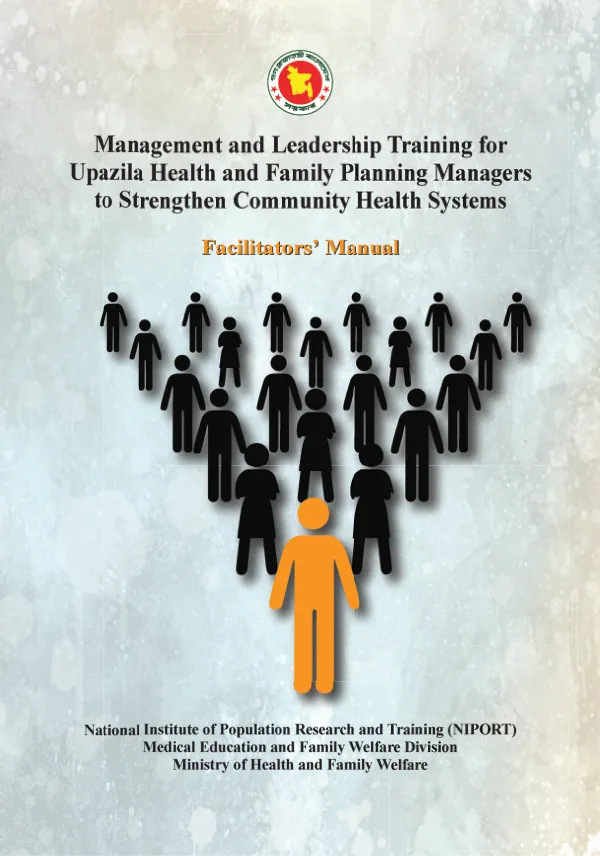
Management and Leadership Training for Upazila Health and Family Planning Managers to Strengthen Community Health Systems Facilitators’ Manual
Sign inJOHNS HOPKINS UNIVERSITY
Management and Leadership Training for Upazila Health and Family Planning Managers to Strengthen Community Health Systems Facilitators’ Manual
The Management and Leadership Training for Upazila Health and Family Planning Managers to Strengthen Community Health Systems is a comprehensive training program aimed at enhancing the capacity of Upazila Health and Family Planning Officers to provide leadership and efficient management support to their teams.
2018 · 239 pages
Sign in to readA free account is required to download.
Abstract
The program is designed to develop a positive approach and proactively engage the community in delivering Essential Service Package (ESP) at community and primary health care facilities. The training program is tailored to address the community health needs of rural Bangladesh, where quality health care is considered the most important first step towards achieving universal health coverage. The program focuses on developing the skills of Upazila health and family planning managers in addressing the community health needs, building on the experience of the Strategic Leadership and Management Training Program (SLMTP) jointly developed and implemented by Johns Hopkins University, Save the Children, and BSMMU under the Health Research Challenge Initiative (HRCI) between 2014 and 2015. The training program consists of 20 sessions, covering topics such as national health, population, and nutrition policies, demographic structure of Bangladesh, national strategies for maternal, adolescent, and nutrition, and essential service package. The program also covers management concepts, leadership, supportive supervision, problem-solving, community-based structure, and data for decision-making. The training program is designed to equip the managers with the necessary skills to lead and manage their teams more efficiently and to proactively engage the Community Health Workers, local government institutions, and various community-based structures. The training program is funded by the United States Agency for International Development (USAID) through the MaMoni Health Systems Strengthening Project. The program is a collaborative effort of many experts inside and outside of the National Institute of Population Research and Training (NIPORT), and the training manuals are comprehensive and developed taking into account the ground realities and challenges faced by the upazila program managers. The training program is expected to contribute to improving the community-based health interventions in the long-term, and the facilitators' manual is designed to guide the facilitators in delivering the training program. The manual provides a detailed guide on the session facilitation, including the objectives, learning objectives, participants, schedule, and session facilitation guide. The training program is a significant addition to the training programs of NIPORT, and it has the potential to raise the quality of basic health services for a large number of population living in rural Bangladesh. The program is expected to bring about meaningful change in the ways health services are provided to the communities across Bangladesh. The training program is designed to be implemented over a period of five days, and the facilitators' manual provides a detailed guide on the session facilitation. The manual is comprehensive and covers all the necessary topics, including national health, population, and nutrition policies, demographic structure of Bangladesh, national strategies for maternal, adolescent, and nutrition, and essential service package. The training program is a significant addition to the training programs of NIPORT, and it has the potential to raise the quality of basic health services for a large number of population
Related documents