USAID DEC
Development Objective 2 Youth Assessment (DO2YA): A Situational Analysis of Western Honduras
Sign inCATHOLIC RELIEF SERVICES ORGANIZATION
Development Objective 2 Youth Assessment (DO2YA): A Situational Analysis of Western Honduras
Youth in western Honduras face significant challenges in their transition from adolescence to adulthood.
2018 · 4 pages
Sign in to readA free account is required to download.
Abstract
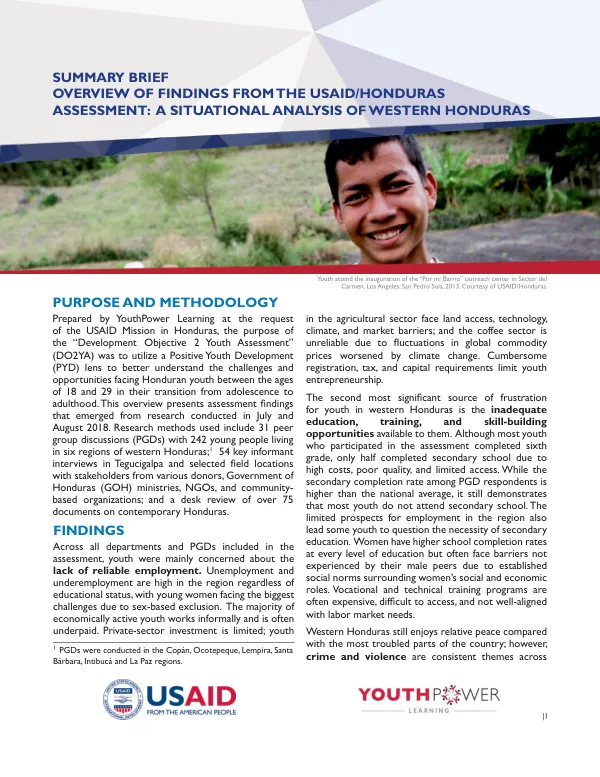
The primary concern among youth is the lack of reliable employment, with high rates of unemployment and underemployment across all educational levels. Young women are disproportionately affected, facing sex-based exclusion and limited opportunities for education, training, and skill-building. The majority of economically active youth work informally and are often underpaid. Private-sector investment is limited, and youth in the agricultural sector face land access, technology, climate, and market barriers. The coffee sector is unreliable due to fluctuations in global commodity prices worsened by climate change. Cumbersome registration, tax, and capital requirements limit youth entrepreneurship. Inadequate education, training, and skill-building opportunities are the second most significant source of frustration for youth in western Honduras. Although most youth complete sixth grade, only half complete secondary school due to high costs, poor quality, and limited access. Women have higher school completion rates at every level of education but often face barriers not experienced by their male peers. Crime and violence are consistent themes across the region, with petty crime, such as theft, being common. More serious crimes, including murder, assault, rape, and extortion, happen frequently. Perspectives shared by youth show that they have become normalized to the homicide rates in some locations. Social and political exclusion are also a key source of youth dissatisfaction. Political polarization runs deep, leading to exclusion from work, civic activities, and local services. There is a deep-rooted sense of corruption in local institutions, and many youth do not trust in them. Additionally, many young people feel shut out of local participation and decision-making spaces. A majority of respondents identified gender inequality as a problem, with a stronger concern among young women than young men. Parents and male partners/husbands often control women's decisions around education, civic participation, and labor participation, and teenage pregnancy is common. Violence against women is highly normalized, and members of the Lesbian, Gay, Bisexual, and Transgender (LGBT) community struggle with acceptance, confront discrimination, and often fear for their security and safety. In addition to limited education, poor employment prospects, and a lack of opportunities for meaningful community engagement, alcohol and drug consumption is common, and many youth see migration as one of the only possible paths to a better future. Several structures and programs are promoting Positive Youth Development (PYD) in Honduras. The DO2YA identified several structures as strengthening the enabling environment for PYD interventions targeting youth in Honduras. These include the GOH, the private sector, and donor-funded programs that have placed high priority on employment and relevant training. Examples of promising local organizations and donor-funded programs that incorporate PYD principles in western Honduras include the Euro+Labor program, ProLempa program, ACCESS to Markets and Alliance for the Dry Corridor (ACS) activities, GEMA, Youth Conservation Corps, Honduras Local Governance (HLG) activity, Jóvenes Constructores, ProJoven II, and Empleando Futuros. These programs aim to address multiple youth-related challenges in western Honduras by providing training, technical support, and capacity-building for youth, as well as promoting improved use of technologies and market access for high-value crops and services. They also focus on building entrepreneurship, job readiness, and life skills among rural youth, providing market- and competencies-based employment, and aligning professional training with market needs.