USAID DEC
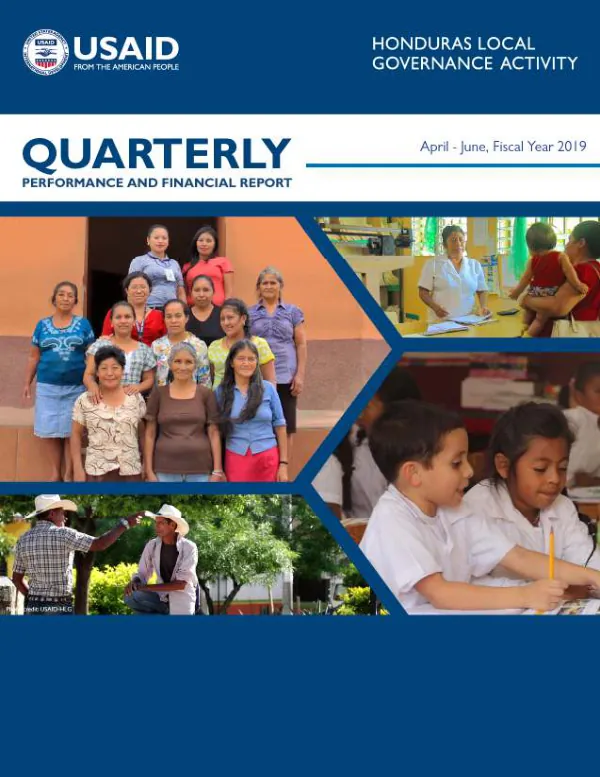
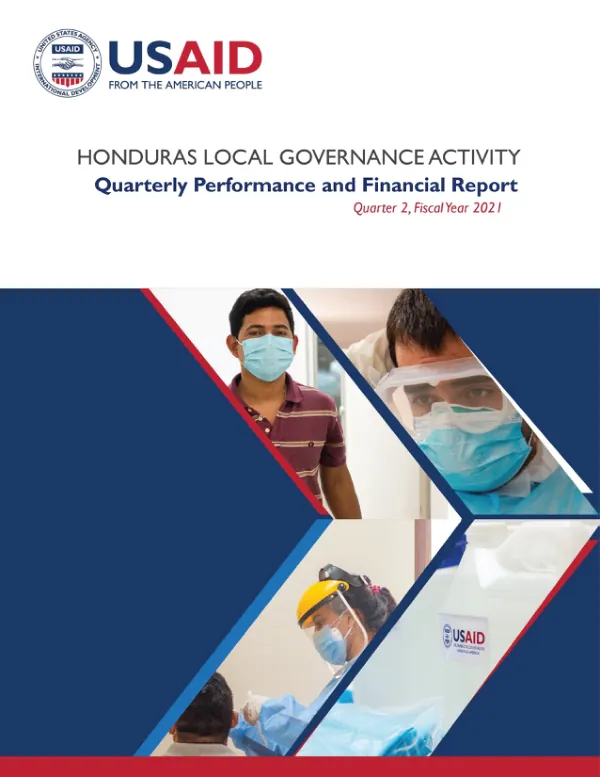
Honduras Local Governance Activity Quarterly Performance and Financial Report January 1 – March 31, 2021
Sign inCATHOLIC RELIEF SERVICES ORGANIZATION
Honduras Local Governance Activity Quarterly Performance and Financial Report January 1 – March 31, 2021
The Honduras Local Governance Activity, sponsored by the USAID Democracy and Governance Office, aims to strengthen local governance and service delivery in Honduras.
2021 · 37 pages
Sign in to readA free account is required to download.
Abstract
The activity focuses on two development objectives: Development Objective 1 (DO1) and Development Objective 2 (DO2), which cover 45 target municipalities. Under Result 1, the activity strengthened citizens' capacity to influence and participate in service delivery decision-making. For example, a forum was held in Macuelizo, Santa Barbara, to raise awareness of citizens' role in service delivery, focusing on current issues such as pandemic response, education, and health services. The event concluded with commitments from health and education service providers to support biosafety committees in education centers and create a community-based COVID-19 Action Plan. Civil society groups demonstrated their self-reliance in providing oversight and following up on local governments' and service providers' commitments. For instance, the CCT in Cabañas followed up on a recommendation for the Mejorando Honduras school network to complete a mapping visualization exercise to identify students with learning disabilities. As a result, ten children with learning disabilities were identified, and the school network will use this information to develop a strategy to better serve their needs. Under Result 2, target municipalities demonstrated their self-reliance in improving their administrative management capacity by exercising their knowledge of the Municipal Administration Career (CAM) Law for transparent human resource practices. Additionally, 10 municipalities improved their use of transparency portals. Thirty-eight target municipalities approved their Municipal Transparency Programs with civil society participation, an activity that has been completed for three consecutive years, becoming increasingly more independent and self-reliant. In the health sector, the activity supported improved COVID-19 prevention and care, including piloting the first COVID-19 community-based action plan with La Labor, Ocotepeque, and training 54 facilitators from nine health regions on the Practical Home Management Guide for Suspected or Confirmed COVID-19 Patients. The activity continues to bolster the self-reliance of education actors to provide improved and accountable services, at the national level with the Secretariat of Education (SEDUC), as well as the departmental, municipal, and school network level. The activity has assisted 17 school networks to begin socializing targeted projects focused on migration, to leverage support and local buy-in for their implementation. The activity has also coordinated with the International Organization for Migration (IOM) to promote the maleta educativa para migracion toolbox, which includes resources for implementing targeted projects such as printable worksheets, videos, activity guides, and event ideas to integrate the conversation on migration into academic plans. The activity has promoted local governments' ability to manage local economic development (LED) processes and structures to reactivate the economy and contribute to curbing irregular migration. The activity has successfully supported Municipal LED Units (UDEL) to build the necessary foundations for effective LED processes and structures.