FHI 360
Development of a Public Health Nutrition Workforce: Nurses and Midwives in Ghana
The Food and Nutrition Technical Assistance III Project (FANTA) collaborated with the Ghana Ministry of Health, the Ghana Health Service, and the Maternal and Child Health Integrated Program to strengthen nutrition in pre-service training for nurses, midwives, and community nutrition officers.
2015 · 2 pages
Sign in to readA free account is required to download.
Abstract
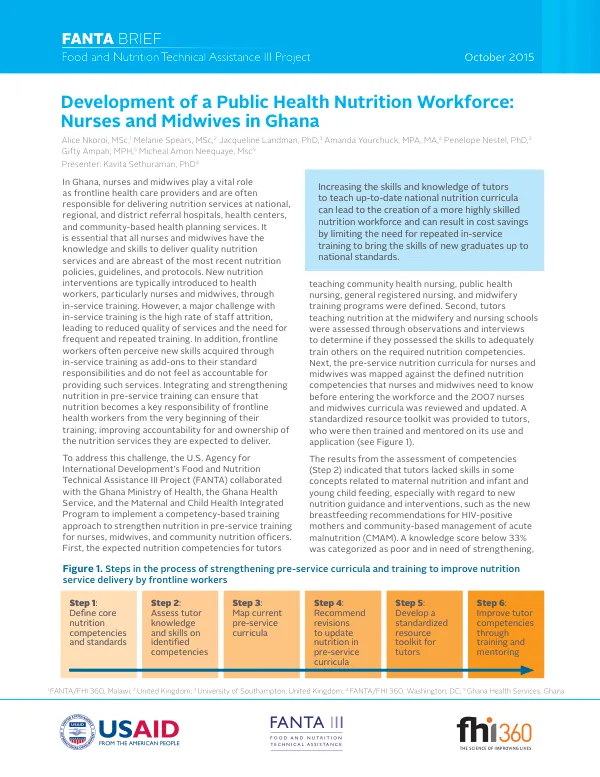
The project aimed to ensure that nutrition becomes a key responsibility of frontline health workers from the beginning of their training, improving accountability for and ownership of the nutrition services they are expected to deliver. In Ghana, nurses and midwives play a vital role as frontline healthcare providers and are often responsible for delivering nutrition services at national, regional, and district referral hospitals, health centers, and community-based health planning services. However, a major challenge with in-service training is the high rate of staff attrition, leading to reduced quality of services and the need for frequent and repeated training. To address this challenge, FANTA implemented a competency-based training approach to strengthen nutrition in pre-service training for nurses and midwives. The project involved six steps: defining core nutrition competencies and standards, assessing tutor knowledge and skills on identified competencies, mapping current pre-service curricula, recommending revisions to update nutrition in pre-service curricula, developing a standardized resource toolkit for tutors, and improving tutor competencies through training and mentoring. The results from the assessment of competencies indicated that tutors lacked skills in some concepts related to maternal nutrition and infant and young child feeding, especially with regard to new nutrition guidance and interventions. A resource toolkit, which included reference materials and session plans, was created to assist tutors with teaching on the required nutrition competencies. The resource toolkit was provided to all tutors and nursing and midwifery training institutions, and resources such as policies, treatment protocols, and equipment were delivered to school libraries and demonstration laboratories. Tutors' skills were strengthened through training and clinical practice in three key nutrition areas: infant and young child feeding, community-based management of acute malnutrition (CMAM) outpatient care, and CMAM inpatient care. Following the assessment, resource toolkit development, and curricula update, the Ghana Health Service, in collaboration with partners, conducted orientation sessions with nursing and midwifery tutors on how to use the resource toolkit, and undertook mentorship visits to nursing and midwifery schools ensuring that the tutors acquired the needed skills to effectively teach the updated nutrition curricula content. A new competency-based nursing and midwifery curricula, which includes the defined nutrition competencies, has been finalized and adopted by the Ghana Nursing and Midwifery Council. The updated curricula is awaiting final dissemination, after which it will be utilized by all nursing and midwifery schools in the country. The project's findings can be partially explained by the fact that the nurses and midwives curricula lacked updated nutrition content and tutors had not received any technical updates on the current nutrition policies, strategies, and approaches. The results of the assessment of tutor competencies related to knowledge and skills in nutrition showed that only 1 of 10 performance areas was considered good, 3 were average, and 7 poor, including the skills of nutrition assessment and nutrition counseling in infant and young child feeding.