USAID DEC
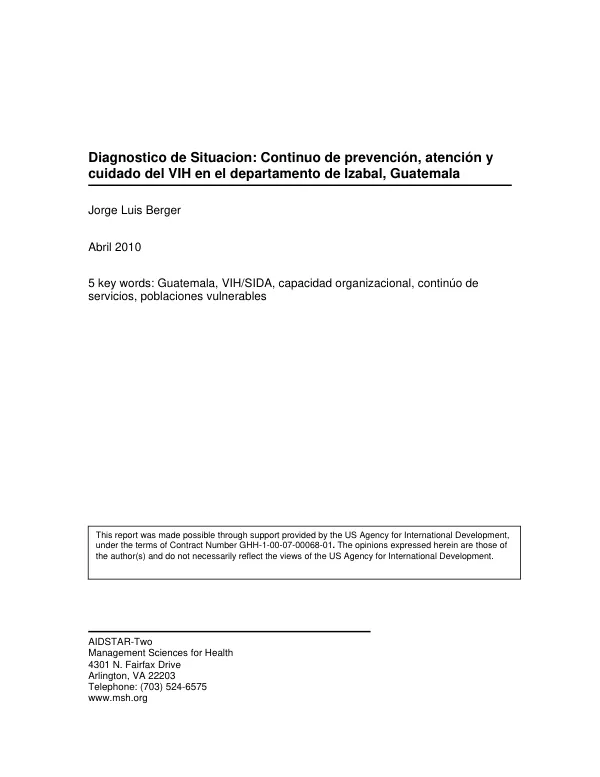
Diagnostico de Situacion: Continuo de prevención, atención y cuidado del VIH en el departamento de Izabal, Guatemala
Sign inMANAGEMENT SCIENCES FOR HEALTH
Diagnostico de Situacion: Continuo de prevención, atención y cuidado del VIH en el departamento de Izabal, Guatemala
The department of Izabal in Guatemala has a concentrated HIV epidemic, with an estimated 1% of the general population and over 5% of specific groups, such as men who have sex with other men (HSH) and sex workers (MTS), being HIV positive.
2010 · 33 pages
Sign in to readA free account is required to download.
Abstract
In the context of Central America, Guatemala accounts for one-sixth of the region's HIV-infected population. Since the detection of the first case in 1984, infections have primarily occurred in key populations more vulnerable to the virus (MARPs): gay, bisexual, and transgender individuals, HSH, and MTS. According to the National Epidemiology Center (CNE), Guatemala reported 20,488 cases of HIV/AIDS as of October 2009. However, the Joint United Nations Programme on HIV/AIDS (ONUSIDA) estimated that the actual number of cases is triple the official reports, with over 3,900 deaths attributed to AIDS. The percentage of infected individuals belonging to key populations is not known. Efforts to prevent HIV among key populations have often failed, with a high rate of new infections among HSH, MTS, and migrant populations, who are at higher risk of contracting the virus. Despite this, resources invested in prevention programs targeting these groups are relatively low, even in concentrated epidemics. The majority of HIV-infected individuals in Guatemala live along transportation routes, primarily affecting urban and Ladino populations. According to the CNE report, as of October 2009, 80% of reported AIDS cases occurred in eight departments, with the highest prevalence rates in Retalhuleu, Izabal, Escuintla, Suchitepéquez, Guatemala, Petén, San Marcos, and Quetzaltenango. HIV prevalence is higher among adults aged 20-39 years. The HIV epidemic in Guatemala is characterized by a high burden of disease among key populations, with a significant proportion of cases occurring in the departments of Izabal, Petén, and other areas with high prevalence rates. The concentrated nature of the epidemic highlights the need for targeted interventions and increased resources to address the specific needs of key populations. The Red de VIH de Izabal, a multisectoral commission established in 2000, plays a crucial role in responding to the HIV epidemic in the department. Although the Red lacks a formal structure and functioning, it has the potential to drive and improve the continuum of HIV prevention, care, and treatment services throughout the department. A diagnostic situation report was conducted to assess the current situation of the continuum of HIV prevention, care, and treatment services in Izabal. The report aimed to identify gaps between the activities of the Red de VIH de Izabal and the continuum of HIV prevention, care, and treatment services, as well as to identify barriers and challenges to achieving the continuum. The report was developed through a workshop with representatives of the organizations involved in the Red de VIH de Izabal, held on January 21, 2010. The report presents the results of the diagnostic situation and provides recommendations for improving the continuum of HIV prevention, care, and treatment services in Izabal. The diagnostic situation report highlights the need for a comprehensive approach to addressing the HIV epidemic in Izabal, including strengthening the capacity of the Red de VIH de Izabal, improving the continuum of HIV prevention, care, and treatment services, and addressing the specific needs of key populations. The report emphasizes the importance of a multisectoral approach to addressing the HIV epidemic, involving government, civil society, and community organizations. It also highlights the need for increased resources and funding to support the implementation of HIV prevention, care, and treatment programs in Izabal. The diagnostic situation report provides a comprehensive overview of the current situation of the continuum of HIV prevention, care, and treatment services in Izabal, highlighting the gaps, barriers, and challenges to achieving the continuum. The report provides recommendations for improving the continuum of HIV prevention, care, and treatment services in Izabal, including strengthening the capacity of the Red de VIH de Izabal, improving the continuum of HIV prevention, care, and treatment services, and addressing the specific needs of key populations.