AGEXPORT
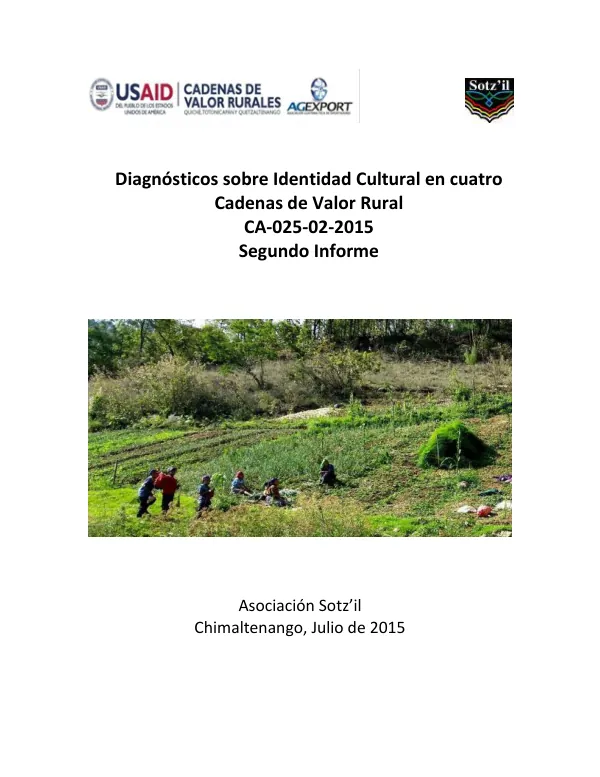
Diagnósticos sobre Identidad Cultural en cuatro Cadenas de Valor Rural
The agricultural development initiative in Guatemala's highlands has a long history of commercial and agricultural skills.
2015 · 88 pages
Sign in to readA free account is required to download.
Abstract
The indigenous peoples of the region have developed emblematic crops such as maize, beans, chile, and ayotes, which are deeply rooted in their culture. However, the introduction of non-native crops has been a constant presence in the region, and the indigenous peoples have become experts in producing crops from distant regions such as Africa, Asia, and Europe. Examples of these crops include cardamomo, café, and hortalizas. The introduction, establishment, and appropriation of these products were made possible by the indigenous peoples' ability to adapt and innovate. This adaptability has allowed them to develop new skills and knowledge, which have been passed down through generations. The indigenous peoples' connection to their land and their cultural heritage has enabled them to maintain their traditional practices while also embracing new technologies and techniques. The Asociación Sotz'il, a local organization, has been working to develop and implement a strategy for cultural identity in the context of the Rural Value Chains Project in the departments of Quiche, Totonicapán, and Quetzaltenango. The project aims to promote and strengthen the cultural identity of the indigenous peoples in these regions. The project has identified four key value chains: the production of cebolla (onion) by the Asociación de Desarrollo Integral Sacapulense (ADIES) in Sacapulas, Quiche; the production of ejote (bean) and arveja (pea) by the Asociación San Luis Sibilá (ASODINE) in San Luis Sibilá, Totonicapán; the production of artesanías (handicrafts) and textiles by the Asociación Chajulense de Mujeres Unidas por la Vida (ACMUV) in Chajul, Quiche; and the production of café by the Asociación Chajulense (AC) in Chajul, Quiche. Each of these value chains has its own unique characteristics and challenges. The production of cebolla by ADIES, for example, involves a complex process of mapeo (mapping) of the territory, cosmovisión (worldview), and analysis of the systems of asociación (association) and encadenamiento (linkage). The production of ejote and arveja by ASODINE involves a similar process, as well as an analysis of the territorialidad (territoriality) and gobernabilidad (governability) of the region. The project has also identified opportunities for the development of new products and services that can help to strengthen the cultural identity of the indigenous peoples. For example, the production of cardamomo, a spice that is native to the region, has been identified as a potential new product that can be developed and marketed. Overall, the project aims to promote and strengthen the cultural identity of the indigenous peoples in the regions of Quiche, Totonicapán, and Quetzaltenango. By supporting the development of new products and services, and by promoting the traditional practices and knowledge of the indigenous peoples, the project hopes to contribute to the economic and social development of these regions. The project has also identified the need to address the challenges faced by the indigenous peoples in terms of their cultural identity. For example, the project notes that the indigenous peoples are often marginalized and excluded from decision-making processes, and that their cultural practices and knowledge are often undervalued and ignored. To address these challenges, the project has proposed a number of recommendations, including the establishment of a cultural identity policy that recognizes and values the cultural practices and knowledge of the indigenous peoples. The project has also proposed the establishment of a cultural identity fund that can provide financial support for the development of new products and services that promote and strengthen the cultural identity of the indigenous peoples.