USAID DEC
DNCC Initiative Overview: Strengthening Nutrition Leadership and Governance in Uganda
Sign inFANTA
DNCC Initiative Overview: Strengthening Nutrition Leadership and Governance in Uganda
The Uganda Nutrition Action Plan 2011-2016 (UNAP) established District Nutrition Coordination Committees (DNCCs) to oversee multi-sectoral nutrition activities at the district level.
2016 · 2 pages
Sign in to readA free account is required to download.
Abstract
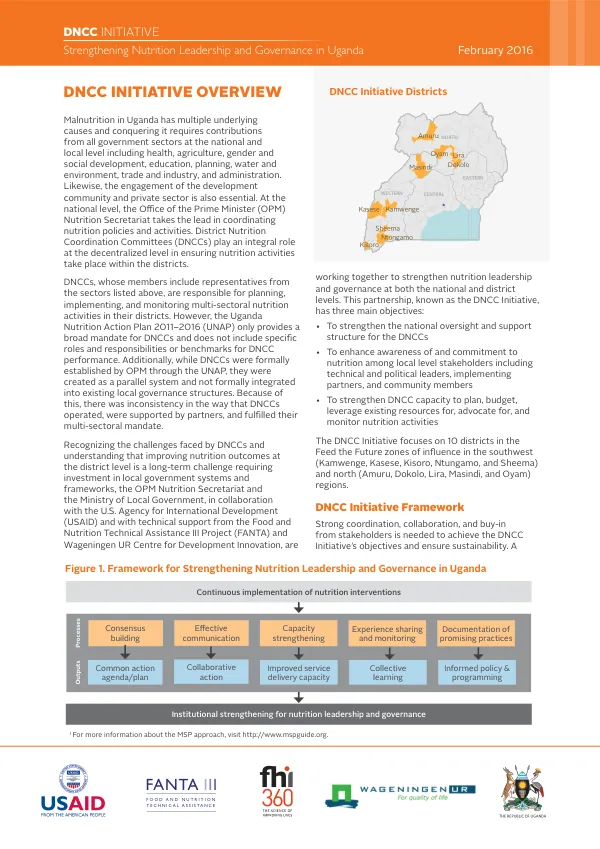
However, the UNAP provided only a broad mandate for DNCCs, lacking specific roles and responsibilities or benchmarks for performance. As a result, DNCCs operated inconsistently, with varying levels of support from partners and fulfillment of their multi-sectoral mandate. To address these challenges, the Office of the Prime Minister (OPM) Nutrition Secretariat and the Ministry of Local Government collaborated with the U.S. Agency for International Development (USAID) and technical support from the Food and Nutrition Technical Assistance III Project (FANTA) and Wageningen UR Centre for Development Innovation to strengthen nutrition leadership and governance at both the national and district levels. This partnership, known as the DNCC Initiative, aimed to improve nutrition outcomes at the district level by investing in local government systems and frameworks. The DNCC Initiative focused on 10 districts in the Feed the Future zones of influence in the southwest and north regions of Uganda. The initiative's objectives were to strengthen the national oversight and support structure for DNCCs, enhance awareness and commitment to nutrition among local stakeholders, and strengthen DNCC capacity to plan, budget, leverage resources, advocate for, and monitor nutrition activities. A multi-stakeholder partnership (MSP) approach was applied to bring together diverse community members with differing mandates and levels of experience with nutrition programming. This approach engaged different perspectives and points of view to clarify and agree on common objectives and expectations, leading to locally owned and sustainable plans to improve nutrition. A DNCC Initiative framework was developed, outlining key processes and outputs required to achieve lasting institutional change. DNCC Initiative activities took place during ongoing implementation of nutrition activities in the target districts, incorporating existing structures and systems. Experience sharing, documentation of promising practices, and learning were ongoing throughout the initiative to ensure its replicability and scalability across other districts seeking to strengthen nutrition leadership and governance. The initiative's activities included consultations with stakeholders, regional and national consensus building events, orientation of the Ministry of Local Government, development of National Nutrition Planning Guidelines, and support to integrate nutrition into district development plans and development of district nutrition action plans. The DNCC Initiative also provided targeted nutrition training for community development officers, district health officers, and district production officers. Technical support was provided to DNCC meetings, advocacy for implementation of nutrition activities at the district level, and events to share experiences and lessons learned. Documentation of lessons learned and compilation of the DNCC toolkit were also ongoing activities.