USAID DEC
Document Data Form - ReWaB
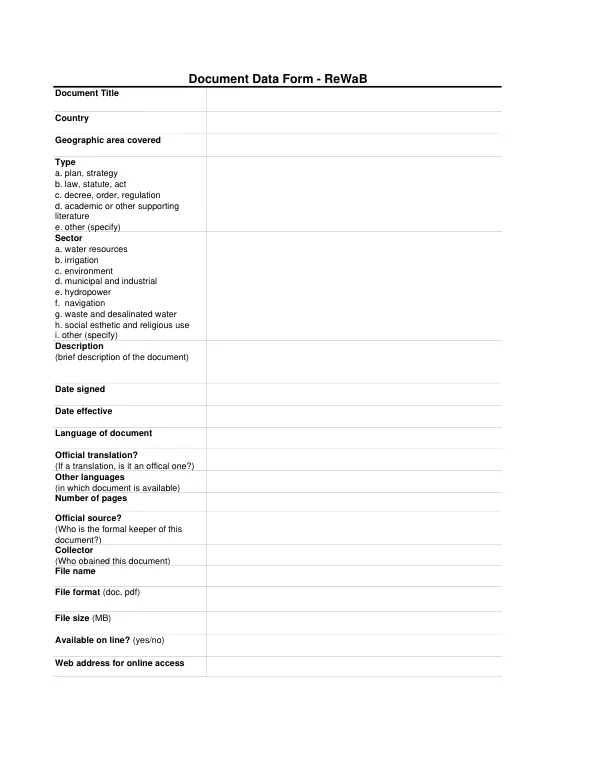
The National Water Resources Strategy for Rwanda was developed to guide the country's water resources management and development.
1 pages
Sign in to readA free account is required to download.
Abstract
Rwanda is a landlocked country in East Africa, with a total area of approximately 26,338 square kilometers. The strategy focuses on the entire country, with a particular emphasis on the Lake Kivu and Lake Tanganyika regions. The strategy is a plan, categorized under sector a. water resources, and is aimed at ensuring the sustainable management and development of Rwanda's water resources. It outlines the country's vision, goals, and objectives for water resources management, as well as the strategies and actions required to achieve these objectives. The strategy is based on a comprehensive analysis of Rwanda's water resources, including its hydrology, water quality, and water use. The strategy identifies several key challenges facing Rwanda's water resources, including inadequate water supply, poor water quality, and limited water infrastructure. To address these challenges, the strategy proposes several interventions, including the development of new water sources, improvement of water treatment and distribution systems, and promotion of water conservation practices. The strategy also emphasizes the importance of integrated water resources management, which involves the coordination of water resources management across different sectors, including agriculture, industry, and energy. The strategy is expected to contribute to the achievement of Rwanda's development goals, including the reduction of poverty and the improvement of living standards. It is also expected to support the country's economic growth and development, particularly in the agriculture and industry sectors. The strategy is a key component of Rwanda's national development plan, and its implementation is expected to have a significant impact on the country's water resources management and development. The strategy is available in English and Kinyarwanda, the official languages of Rwanda. It is available online, and can be accessed through the website of the Ministry of Natural Resources. The strategy is a comprehensive document, consisting of 120 pages, and is available in PDF format.
Related documents