USAID DEC
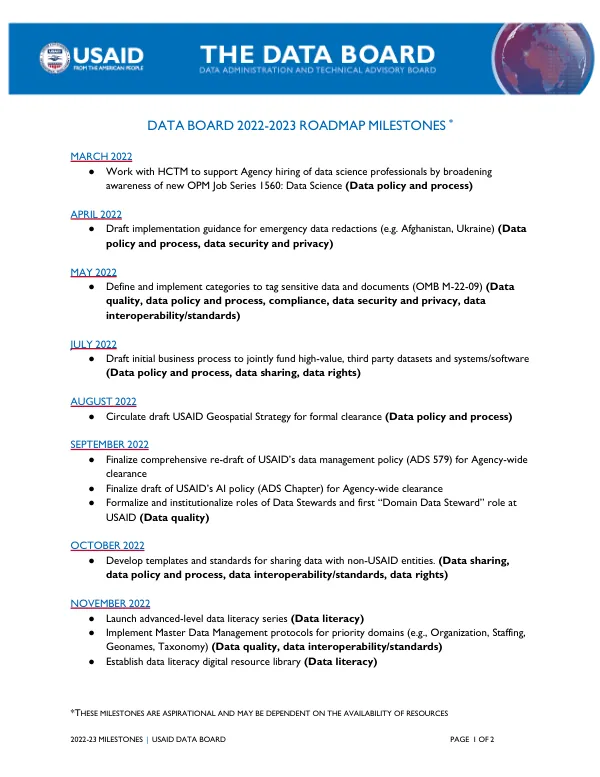
USAID DATA BOARD 2022-2023 ROADMAP MILESTONES
The USAID Data Board 2022-2023 Roadmap outlines key milestones for advancing data management and utilization across the Agency.
2022 · 2 pages
Sign in to readA free account is required to download.
Abstract
The initiative began in March 2022 with a focus on supporting Agency hiring of data science professionals through awareness campaigns for the new OPM Job Series 1560: Data Science. This effort aimed to broaden the pool of skilled professionals available for data-driven decision-making. In April 2022, the Data Board drafted implementation guidance for emergency data redactions, addressing sensitive data and documents related to crises such as those in Afghanistan and Ukraine. The guidance balanced data security and privacy concerns with the need for timely access to critical information. The following month, the Board defined and implemented categories to tag sensitive data and documents, aligning with OMB M-22-09 requirements. The summer months saw significant progress, with the Data Board drafting initial business processes for jointly funding high-value datasets and systems/software in July 2022. This move aimed to facilitate data sharing and collaboration across the Agency and with external partners. In August 2022, the Board circulated a draft USAID Geospatial Strategy for formal clearance, marking a key step in the development of a comprehensive geospatial framework. The fall season brought a flurry of activity, with the Data Board finalizing a comprehensive re-draft of USAID's data management policy (ADS 579) for Agency-wide clearance in September 2022. The Board also finalized a draft of USAID's AI policy (ADS Chapter) and formalized the roles of Data Stewards and the first "Domain Data Steward" role at USAID. These developments aimed to enhance data quality, interoperability, and standards across the Agency. The remainder of 2022 and 2023 saw continued momentum, with the Data Board developing templates and standards for sharing data with non-USAID entities in October 2022. The Board also launched an advanced-level data literacy series, implemented Master Data Management protocols for priority domains, and established a data literacy digital resource library in November 2022. These efforts aimed to enhance data sharing, interoperability, and access to data tools across the Agency. In the first half of 2023, the Data Board generated demo videos, job aids, and manuals to broaden awareness of USAID data technologies, increased awareness and use of USAID's source code repository, and drafted initial implementation guidance for the use of data from social media, digital exhaust, airborne drones, seismic sensors, and other sources. The Board also delivered a final plan for the USAID Data Literacy Certification Program and finalized USAID's new rule on Digital Information in April 2023. The second half of 2023 saw further progress, with the Data Board procuring a solution to automate Tableau dashboard data refreshes, launching a public-facing site providing interactive access to generalized USAID activity locations and details from USAID's Development Information Solution, and developing implementation guidance for public sharing of non-English data. The Board also established a Development Data Commons (DDC) shared computing platform in December 2023, marking a significant milestone in the development of a shared data infrastructure across the Agency.
Related documents