USAID DEC
Documentation of Community Health Extension Worker (CHEW) pilot Costs and Implementation model
Sign inUSAID
Documentation of Community Health Extension Worker (CHEW) pilot Costs and Implementation model
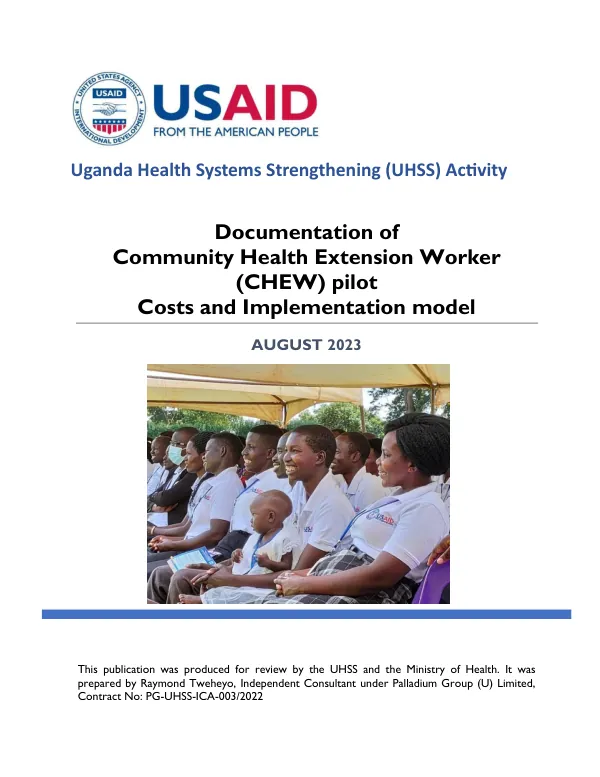
The Community Health Extension Worker (CHEW) pilot in Uganda aimed to strengthen the country's health system by introducing a new cadre of community health workers.
2023 · 41 pages
Sign in to readA free account is required to download.
Abstract
The pilot was implemented in several districts, with the primary objective of improving access to healthcare services, particularly for marginalized and hard-to-reach populations. The CHEW program was designed to address the shortage of healthcare professionals in rural areas, where the majority of the population resides. The program involved the recruitment, training, and deployment of CHEWs, who were responsible for providing basic healthcare services, including antenatal care, delivery care, and management of common illnesses such as malaria and tuberculosis. The implementation model for the CHEW pilot involved several key components, including site readiness assessment and selection, training plans and iterations, deployment, supervision and mentorship, and CHEW program performance. Site readiness assessment and selection involved identifying districts with the greatest need for the CHEW program and ensuring that the necessary infrastructure and resources were in place to support its implementation. Training plans and iterations were developed to equip CHEWs with the necessary skills and knowledge to provide high-quality healthcare services. The training program included both theoretical and practical components, with a focus on topics such as maternal and child health, infectious diseases, and basic life support. Deployment of CHEWs involved innovations that circumvented bureaucracy and ensured that the CHEWs were able to reach the most vulnerable populations. This included the use of mobile health technologies and community-based approaches to deliver healthcare services. Supervision and mentorship were critical components of the CHEW program, with a focus on providing ongoing support and guidance to CHEWs to ensure that they were able to provide high-quality healthcare services. A systems and multi-sectoral approach was used to supervise and mentor CHEWs, involving collaboration with local government officials, healthcare providers, and community leaders. The CHEW program performance was evaluated through stakeholder perspectives and evidence. The evaluation revealed that the program had a positive impact on healthcare outcomes, with improvements in antenatal care, delivery care, and management of common illnesses. The program also had a positive impact on the health system, with increased access to healthcare services and improved health outcomes for marginalized and hard-to-reach populations. The costing approach used for the CHEW pilot involved collecting data on the costs of implementing the program, including personnel costs, training costs, and infrastructure costs. The data was then analyzed to determine the total annual cost expenditure for the CHEW program by category, as well as the total annual economic costs for the CHEW program by category. The results of the costing analysis revealed that the CHEW program had a significant impact on healthcare costs, with a reduction in costs associated with hospitalizations and a reduction in costs associated with healthcare services. The program also had a positive impact on the health system, with increased access to healthcare services and improved health outcomes for marginalized and hard-to-reach populations. The CHEW pilot in Uganda provides a model for strengthening health systems in low- and middle-income countries. The program's focus on community-based healthcare delivery, supervision and mentorship, and costing approach provides a framework for other countries to follow. The program's positive impact on healthcare outcomes and health system strengthening makes it a valuable example of how to improve health outcomes in resource-constrained settings.