GIZ
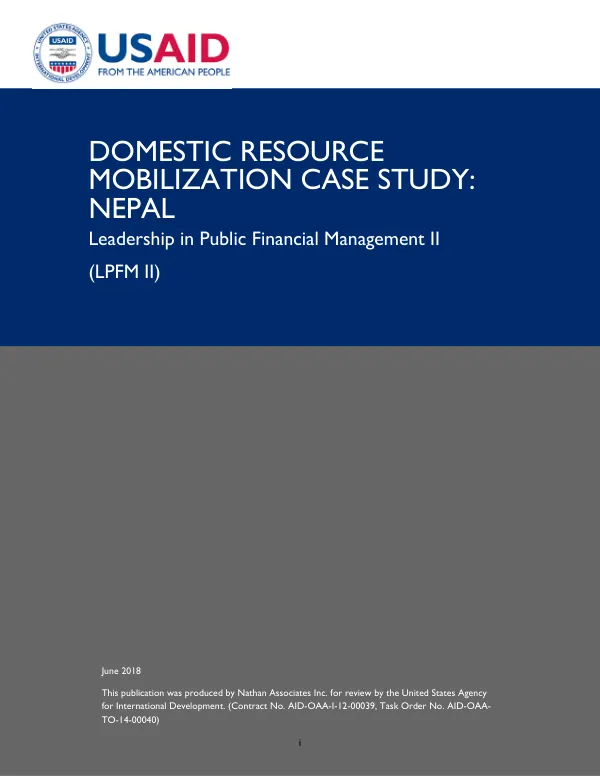
Domestic Resource Mobilization Case Study: Nepal
Nepal's domestic revenue mobilization efforts have achieved remarkable improvement in tax performance.
2018 · 32 pages
Sign in to readA free account is required to download.
Abstract
Between fiscal year 1999/2000 and 2015/16, total domestic revenue climbed from 11.3 percent of GDP to 21.6 percent, while tax receipts rose from 8.7 percent of GDP to 18.7 percent. The biggest revenue gain accrued from the Value Added Tax (VAT), which more than doubled from 2.6 percent of GDP to 5.4 percent over that period. The improvement in Nepal's tax performance is partly due to the natural responsiveness of VAT and income tax to economic growth, and partly due to the government's reform efforts, supported by international agencies such as the IMF, USAID, World Bank, Danida, and GIZ. A key factor has been a rapid increase in workers' remittances from 16 percent of GDP in 2006 to 30 percent in 2016. This fueled an expansion (relative to GDP) in imports and consumption expenditures, yielding revenue gains in VAT, excise duty, and trade tax. Beyond these underlying economic dynamics, the Government of Nepal (GON) has pursued a long-term program of reforms to tax policy and tax administration. The most important tax policy measures were implemented in the early 1990s, particularly the introduction of VAT in 1997 at a 10 percent tax rate. GON subsequently pursued a series of administration reforms, including development of ICT; functional reorganization; operational segmentation by taxpayer size; improvements in frontline taxpayer services; and improvements in risk management. The case of Nepal illustrates several basic lessons about domestic resource mobilization. First, and foremost, Nepal's performance demonstrates that impressive gains in revenue performance are achievable, even in post-conflict conditions with prolonged periods of political turmoil. Second, the cornerstones for strengthening revenue performance included the introduction of sound policy measures, supported by sensible administrative reforms. Third, tax reform is a long-term process: major reforms implemented in the 1990s in Nepal paid off in recent years with remarkable improvements in revenue performance. The Government of Nepal recognizes further reforms are needed, including implementing a Single Tax Code to consolidate the legal framework for major taxes; rationalizing tax incentives; and improving compliance. The country's success in mobilizing domestic revenue has been driven mainly by the service sector, which expanded by 5.3 percent per year over the decade to 2016. A large share of economic activity is still concentrated in smallholder agriculture and micro-, small and medium enterprises, most of which operate in the informal sector. Nepal's domestic revenue mobilization efforts have been supported by international agencies, including the IMF, USAID, World Bank, Danida, and GIZ. The country's success in strengthening its domestic revenue mobilization efforts has been recognized as a model for other developing countries. The case of Nepal highlights the importance of host country ownership in driving successful domestic resource mobilization efforts. The country's experience also underscores the need for a long-term approach to tax reform, as well as the importance of addressing corruption and improving compliance. The Government of Nepal has made significant progress in strengthening its tax administration, including the development of ICT; functional reorganization; operational segmentation by taxpayer size; improvements in frontline taxpayer services; and improvements in risk management. The country's tax policy reforms have also been supported by international agencies, including the IMF, USAID, World Bank, Danida, and GIZ. The case of Nepal demonstrates that impressive gains in revenue performance are achievable, even in post-conflict conditions with prolonged periods of political turmoil.