USAID DEC
Effectiveness of Local Governments in Nepal to Address the COVID-19 Crisis: Assessment Report
Sign inNORC AT THE UNIVERSITY OF CHICAGO
Effectiveness of Local Governments in Nepal to Address the COVID-19 Crisis: Assessment Report
The COVID-19 pandemic presented unprecedented challenges to governments worldwide, including Nepal, where the crisis led to widespread lockdowns, mass unemployment, and economic disruption.
2021 · 102 pages
Sign in to readA free account is required to download.
Abstract
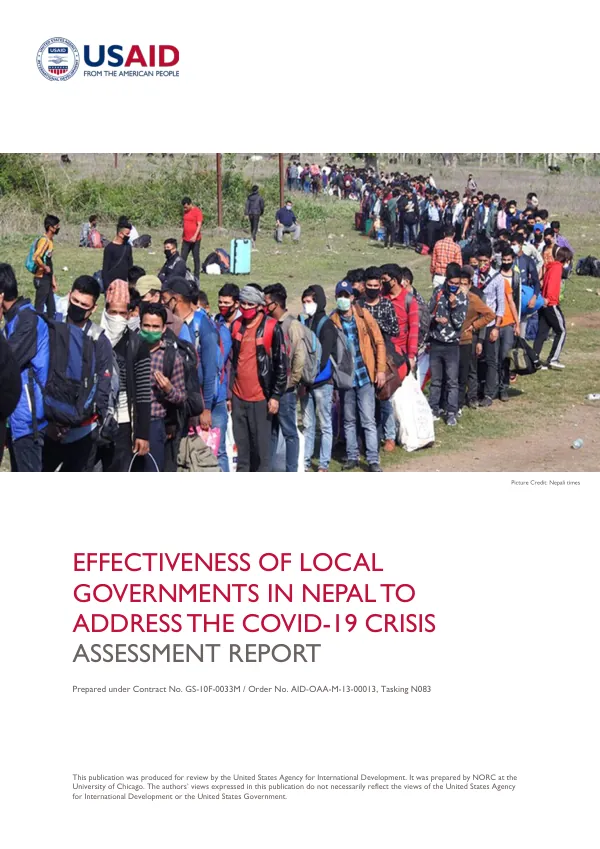
As of August 28, 2020, Nepal had 36,456 cases with 195 deaths, and by April 4, 2021, the figure had increased to 277,944 cases with 3,032 deaths. In response to the crisis, the United States Agency for International Development (USAID) contracted NORC at the University of Chicago to conduct research on the effectiveness of local governments in addressing the COVID-19 crisis in Nepal. The research focused on four key research questions at the local level, specifically in Province 2 and Province 7 (Sudurpaschim). Research Question 1 examined the functions of local governments with respect to COVID-19 response, including the roles and responsibilities of municipalities and wards, and their cooperation and coordination with other levels of government. Research Question 2 focused on the capacity of local governments to deliver COVID-19 related services, including the provision of services and the perception of the public towards local governments. Research Question 3 investigated whether local governments developed partnerships with other entities, such as civil society organizations and the private sector, in the provision of COVID-19 related services, and the ways in which they did so. Research Question 4 described the funds mobilized and provided for COVID-19 response, the systems of control and transparency established, and how funds were used. NORC collected data from both the supply side (entities providing the COVID-19 response) and the demand side (citizens, nongovernmental organizations, and private sector actors requesting a response due to the pandemic). Key informant interviews were conducted with local government officials, federal government officials, USAID implementing partners, and donor staff. Focus group discussions were conducted with citizen beneficiaries of COVID-19 services, civil society organizations, and private sector representatives. The research found that local governments in Nepal faced significant challenges in responding to the COVID-19 crisis, including a lack of clear functional responsibilities, coordination, and collaboration between the federal, provincial, and local levels of government. The provision of health and economic services at the municipal level was exacerbated by the challenges in implementing a constitutionally mandated transition to a more decentralized form of government. The research also found that local governments in Nepal developed partnerships with other entities, such as civil society organizations and the private sector, in the provision of COVID-19 related services. However, the effectiveness of these partnerships varied, and there were challenges in coordinating and collaborating between different levels of government. The research highlighted the need for clear functional responsibilities, coordination, and collaboration between the federal, provincial, and local levels of government in providing COVID-19 related services. It also emphasized the importance of developing partnerships with other entities, such as civil society organizations and the private sector, in addressing the COVID-19 crisis. The research findings have implications for the development of policies and programs aimed at improving the effectiveness of local governments in responding to the COVID-19 crisis in Nepal. They also highlight the need for continued support and capacity building for local governments in Nepal to enhance their ability to respond to future crises.