USAID DEC
Feed the Future Enabling Environment for Food Security Project Policy Data Snapshot: Nepal
Sign inUSAID
Feed the Future Enabling Environment for Food Security Project Policy Data Snapshot: Nepal
The Enabling Environment for Food Security Project in Nepal is a key component of the Feed the Future initiative, aimed at improving the country's agricultural sector.
2018 · 2 pages
Sign in to readA free account is required to download.
Abstract
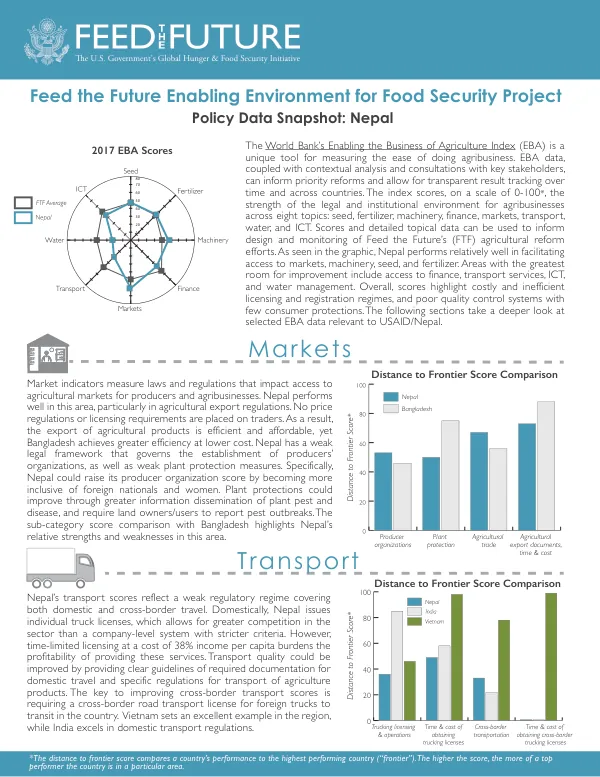
The project utilizes the Enabling the Business of Agriculture Index (EBA) to assess the ease of doing agribusiness in Nepal. The EBA scores, on a scale of 0-100, evaluate the strength of the legal and institutional environment for agribusinesses across eight topics: seed, fertilizer, machinery, finance, markets, transport, water, and ICT. Nepal performs relatively well in facilitating access to markets, machinery, seed, and fertilizer, with scores ranging from 60 to 80. However, areas with the greatest room for improvement include access to finance, transport services, ICT, and water management. The scores highlight costly and inefficient licensing and registration regimes, as well as poor quality control systems with few consumer protections. Market indicators measure laws and regulations that impact access to agricultural markets for producers and agribusinesses. Nepal performs well in this area, particularly in agricultural export regulations. The country has a weak legal framework governing the establishment of producers' organizations, as well as weak plant protection measures. Nepal could raise its producer organization score by becoming more inclusive of foreign nationals and women, and improve plant protections through greater information dissemination of plant pest and disease, and requiring land owners/users to report pest outbreaks. Nepal's transport scores reflect a weak regulatory regime covering both domestic and cross-border travel. Domestically, Nepal issues individual truck licenses, which allows for greater competition in the sector than a company-level system with stricter criteria. However, time-limited licensing at a cost of 38% income per capita burdens the profitability of providing these services. Transport quality could be improved by providing clear guidelines of required documentation for domestic travel and specific regulations for transport of agriculture products. The key to improving cross-border transport scores is requiring a cross-border road transport license for foreign trucks to transit in the country. The regulatory framework for tractors in Nepal is a proxy for all agricultural machinery. Sub-indicators measure access through import, registration requirements, and quality and safety standards. Streamlined import procedures facilitate easy import into Nepal. Once in the country, registration is required and administered in an efficient (2 days) and affordable (4% income per capita) manner. However, operational safety, performance, and longevity of machinery is not legally safeguarded in Nepal. The country has adopted neither national nor international tractor standards; vendors are not required to provide ongoing maintenance service; and type approval requiring certain testing is not required of tractors before they enter the market. Restrictive import requirements and lengthy registration procedures pose bottlenecks to accessing fertilizer in Nepal. Companies must first register as importers (valid for one year) and then obtain per-shipment import permits (also valid for one year). This is in stark comparison to India, who does not require any specific registration or permits for fertilizer imports. Once in Nepal, registration of new fertilizers is more time consuming and costly than India or Sri Lanka. Quality control measures are sufficient, but could improve by prohibiting the sale of fertilizer products from opened bags and setting penalties accordingly. On the whole, inefficient and expensive import and registration requirements limit access to these important yield-boosting technologies.
Related documents