USAID DEC
Draft Goals, Objectives & Strategies for Afghanistan's National Protected Area System Plan (NPASP)
Sign inUSAID DEC
Draft Goals, Objectives & Strategies for Afghanistan's National Protected Area System Plan (NPASP)
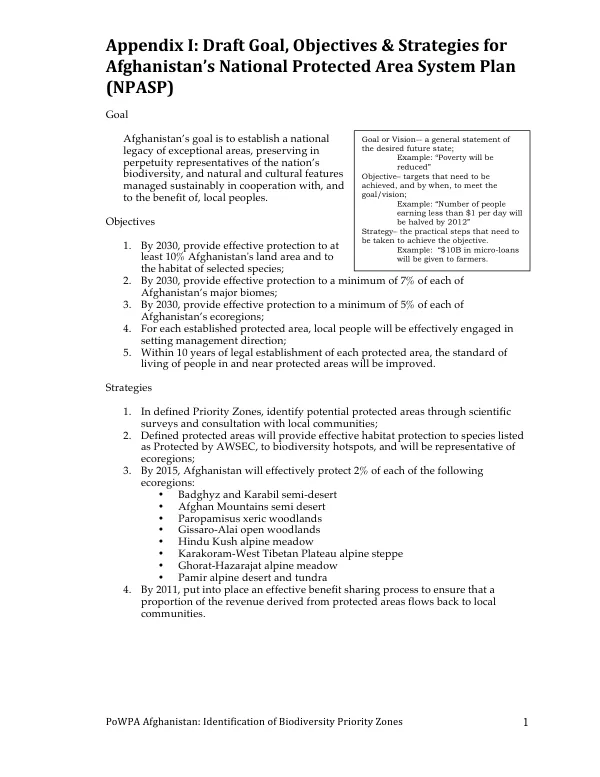
Afghanistan's National Protected Area System Plan (NPASP) aims to establish a national legacy of exceptional areas, preserving in perpetuity representatives of the nation's biodiversity, and natural and cultural features managed sustainably in cooperation with, and to the benefit of, local peoples.
1 pages
Sign in to readA free account is required to download.
Abstract
The plan seeks to provide effective protection to at least 10% of Afghanistan's land area and to the habitat of selected species by 2030. Additionally, the plan targets the protection of a minimum of 7% of each of Afghanistan's major biomes and 5% of each of Afghanistan's ecoregions by 2030. To achieve these objectives, the plan employs several strategies. First, potential protected areas will be identified through scientific surveys and consultation with local communities in defined Priority Zones. These protected areas will provide effective habitat protection to species listed as Protected by AWSEC, to biodiversity hotspots, and will be representative of ecoregions. By 2015, Afghanistan aims to effectively protect 2% of each of the following ecoregions: Badghyz and Karabil semi-desert, Afghan Mountains semi desert, Paropamisus xeric woodlands, Gissaro-Alai open woodlands, Hindu Kush alpine meadow, Karakoram-West Tibetan Plateau alpine steppe, Ghorat-Hazarajat alpine meadow, and Pamir alpine desert and tundra. Furthermore, the plan emphasizes the importance of engaging local people in setting management direction for each established protected area. By 2030, the standard of living of people in and near protected areas is expected to be improved within 10 years of legal establishment of each protected area. To ensure that local communities benefit from the protected areas, an effective benefit-sharing process will be put into place by 2011. This process will ensure that a proportion of the revenue derived from protected areas flows back to local communities. The plan's goal and objectives are aligned with the concept of a general statement of the desired future state, targets that need to be achieved, and by when, to meet the goal/vision. The strategies outlined in the plan represent the practical steps that need to be taken to achieve the objectives. The implementation of the NPASP will require a coordinated effort from various stakeholders, including government agencies, local communities, and international organizations.
Related documents