USAID DEC
Draft Outline: Land and Technology Solutions (LTS) Project Quarterly Report Year 3, Quarter 3: September 1, 2017 through November 30, 2017
Sign inSSG ADVISORS, LLC
Draft Outline: Land and Technology Solutions (LTS) Project Quarterly Report Year 3, Quarter 3: September 1, 2017 through November 30, 2017
The Land Technology Solutions (LTS) Project is a USAID-funded initiative aimed at improving land and resources governance and strengthening property rights in developing countries through the use of mobile technology.
2017 · 24 pages
Sign in to readA free account is required to download.
Abstract
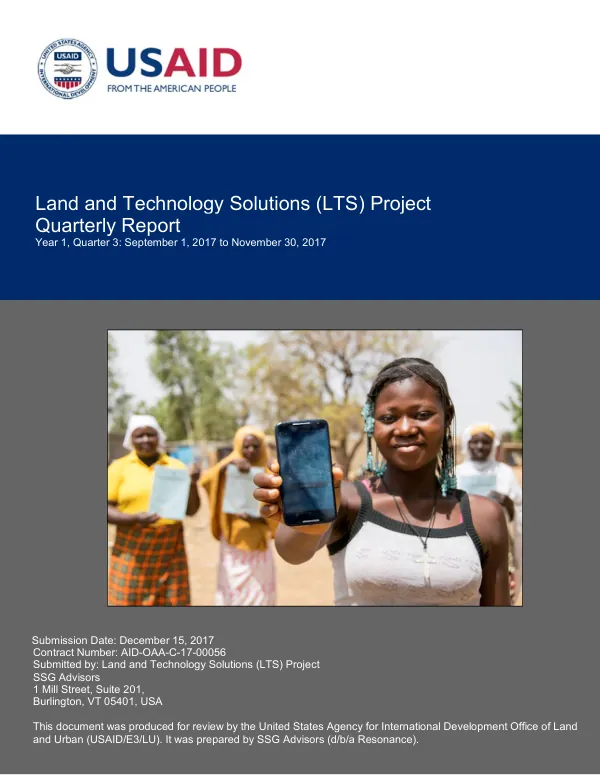
The project's primary objective is to promote the use of USAID's Mobile Applications to Secure Tenure (MAST) as a scalable, worldwide, "fit-for-purpose" land technology framework and delivery mechanism. LTS is envisioned to empower communities, especially women, with information and documentation needed to secure land rights, reduce gender equality gaps in land security, and plan investments in land. The project will also provide evidence to inform USAID programming in food security, environment, democracy, and governance. Additionally, LTS will develop a set of tools and resources for USAID and host-country counterparts to determine the applicability of MAST in the local context, the local sustainability of its implementation, and feasibility. During the third quarter of Year 1, LTS completed several key tasks and activities. Task 0.0, General and Administrative Project Mobilization, involved developing a Work Plan for Year 1, which was updated and re-submitted to reflect changes discussed with the Contracting Officer's Representative (COR) and Alternate COR (A/COR). LTS also developed a Monitoring, Evaluation, and Learning Plan (MELP), which was approved by USAID on September 6, 2017. The MELP outlines a theory of change and details a set of indicators to be used during the LTS project. Task 0.3, Advisory Committee, involved forming and availing of the services of a professional Advisory Committee. The Committee's purpose is to provide overarching guidance to the project and is expected to meet four times a year. The Advisory Committee is led by the LTS Chief of Party (COP) and is comprised of experts across three technical areas: technology, land tenure, and implementation. Task 1.0, New MAST GitHub Project and a Land Technology Learning Platform, involved updating the MAST software and developing a land technology learning platform. Task 1.2, Contract software development team for the update of MAST, involved choosing to utilize the base code from the Land Tenure Assistance Project (LTA) project. The LTS sub-contractor, RMSI, updated some key workflow items and key components and functionalities. However, delays associated with software development have predicated the need to extend RMSI's deliverables schedules via two separate contract modifications. The LTS project has made significant progress in the third quarter of Year 1, with several key tasks and activities completed. The project's objectives and scope are aligned with USAID's development objectives, and the project is expected to contribute to improved land and resources governance and strengthened property rights in developing countries.