USAID DEC
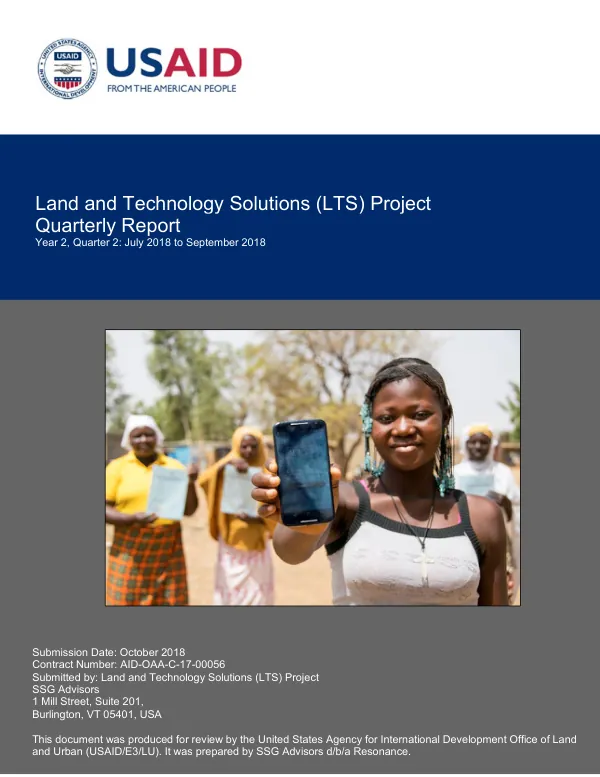
USAID Land Technology Solutions (LTS) Project Quarterly Report Year 1, Quarter 1: April 2017 to June 2017
Sign inSSG ADVISORS, LLC
USAID Land Technology Solutions (LTS) Project Quarterly Report Year 1, Quarter 1: April 2017 to June 2017
The USAID Land Technology Solutions (LTS) Project aims to improve land and resources governance and strengthen property rights for all members of society in developing countries through the use of mobile technology.
2017 · 20 pages
Sign in to readA free account is required to download.
Abstract
The project's purpose is to enable host-country stakeholders to document land rights cheaply, quickly, and efficiently. LTS is envisioned to promote MAST as a scalable, worldwide, "fit-for-purpose" land technology framework and delivery mechanism to make it easier, cheaper, and faster to map and document land rights, and to learn critical information about land and its productivity potential. The LTS Project will be implemented in up to 4 selected countries to provide a cost-effective, customizable ("fit-for-purpose") community-based technology framework within sustainable local systems to map and document land rights, and to clarify and secure land-based resources under different tenure regimes. The project will also facilitate the uptake of "fit for purpose" mobile applications at the Mission and host country levels, empower communities, especially women, with information and documentation needed to secure land rights, reduce gender equality gaps in land security, and to plan investments in land. The project will be implemented by SSG Advisors and its subcontractor Tetra Tech under USAID Contract No. AID-OAA-C-17-00056. The first Quarterly Report summarizes the activities and tasks completed during the 3-month project period April 1, 2017 through June 15, 2017. The report outlines the progress made in various tasks, including project mobilization, development of a work plan, monitoring, evaluation, and learning plan, and advisory committee formation. Task 0.0: Project Mobilization involved developing a work plan for Year 1 of LTS, which was initially presented to USAID during a Work Planning Workshop on 5/22/17, and then resubmitted on 6/15/17 after receiving comments from USAID on 6/6/2017. Task 0.1 involved developing a monitoring, evaluation, and learning plan, which was submitted on 5/17/2017 and revised on 6/13/2017. Task 0.3 involved forming and coordinating a formal Advisory Committee to draw from a wide range of technical expertise to propagate knowledge and incorporate lessons learned from USAID land tenure projects and beyond. Task 1: New MAST GitHub Project and a Land Technology Learning Platform involved updating the release of MAST, which included executing and submitting a Critical Technology Analysis (CTA) report to USAID, contracting a software development team for the update of MAST, working with USAID/E3/LU to develop an appropriate licensing model for MAST Technologies, and uploading MAST to GitHub and deploying updated MAST on Amazon Cloud Server. Task 1.2 involved developing, launching, and supporting a Land Technology Learning Platform, which included developing a conceptual design and content for the platform, working with ERC and its contractor Cloudburst Consulting Group in deploying the platform, and providing a conceptual document that outlines the format of the platform and content. The project has made significant progress in the first quarter, with the development of a work plan, monitoring, evaluation, and learning plan, and the initiation of research into licensing arrangements for MAST Technologies. The project is expected to continue making progress in the second quarter, with the formalization of the LTS Advisory Committee and the development of the Land Technology Learning Platform.