NORC AT THE UNIVERSITY OF CHICAGO
DRC Countering Trafficking in Persons (C-TIP) Assessment
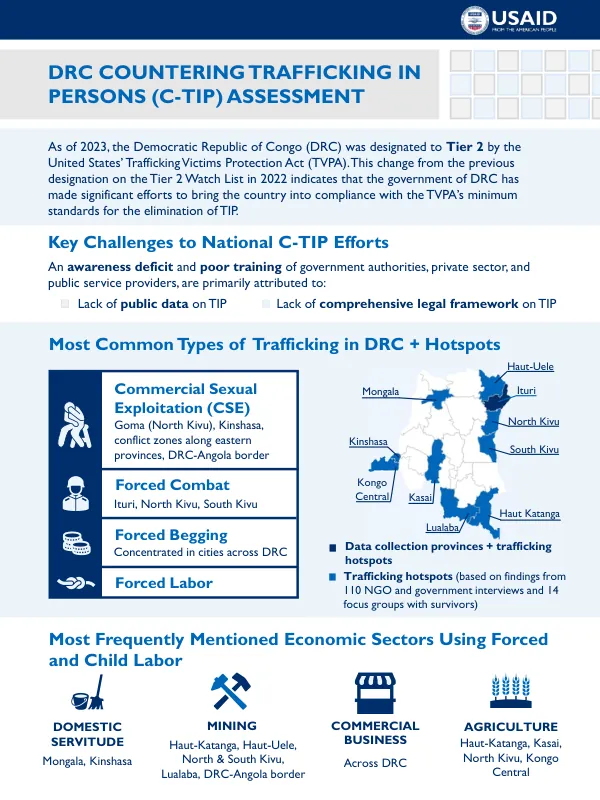
The Democratic Republic of Congo (DRC) was designated to Tier 2 by the United States' Trafficking Victims Protection Act (TVPA) as of 2023.
2023 · 2 pages
Sign in to readA free account is required to download.
Abstract
This designation indicates that the government of DRC has made significant efforts to bring the country into compliance with the TVPA's minimum standards for the elimination of Trafficking in Persons (TIP). The country's previous designation on the Tier 2 Watch List in 2022 reflects progress in addressing TIP. Key challenges to national C-TIP efforts in DRC include an awareness deficit and poor training of government authorities, private sector, and public service providers. These challenges are attributed to a lack of public data on TIP and a lack of comprehensive legal framework on TIP. The absence of reliable data and a clear legal framework hinders effective implementation of anti-TIP measures. Trafficking hotspots in DRC are concentrated in specific regions and cities. Commercial Sexual Exploitation (CSE) is prevalent in Goma (North Kivu), Kinshasa, and conflict zones along eastern provinces, as well as the DRC-Angola border. Forced Combat is found in Ituri, North Kivu, and South Kivu, while Forced Begging is concentrated in cities across DRC. Forced Labor is most frequently mentioned in the mining, agriculture, commercial business, and domestic servitude sectors, with hotspots in Haut-Katanga, Haut-Uele, North & South Kivu, Lualaba, and the DRC-Angola border. Traffickers in DRC often possess significant resources and control mechanisms, including border crossings and transportation networks. They target vulnerable populations, including minors, women in poverty, young girls, and widows, as well as internally displaced individuals and those from neighboring countries. Risk factors and vulnerabilities include socioeconomic conditions, lack of employment opportunities, and extreme poverty, particularly among ethnic groups such as Bayakhas, Pygmies, Bakete, and Chokwe. National C-TIP action in DRC involves identification, monitoring, and denunciations of TIP cases. NGOs work directly with vulnerable populations, establishing early warning mechanisms to flag potential cases to partner NGOs. The Commission of Inquiry and Investigation within the Agency for the Prevention and Fight against Trafficking Persons (APLTP) identifies child trafficking survivors, while INTERPOL supports investigative training to identify cross-border trafficking. Prevention activities in DRC include awareness raising, advocacy, and information sharing. NGOs target at-risk populations, including children, schools, specific communities, customs authorities, and the public. APLTP focuses on general public awareness through workshops, seminars, leaflets, radio programs, and rights awareness programs. Other prevention activities include stakeholder mapping, hotlines, monitoring, and economic support. Protection activities in DRC focus on providing legal aid, social aid, and reintegration services to survivors. Many NGOs and CSOs collaborate with the Ministry of Social Affairs (MSA) and IOM to share processes and information, coordinate housing and victim care, and prevent revictimization. Protection activities are targeted to survivors based on age and vulnerability to trafficking, and include accompaniment to legal proceedings, mental health service provision, and community mediation.