NORC AT THE UNIVERSITY OF CHICAGO
Terms and Approaches to Address Mental Health
Mental health is an integral part of general health, as emphasized by the slogan "no health without mental health."
2023 · 7 pages
Sign in to readA free account is required to download.
Abstract
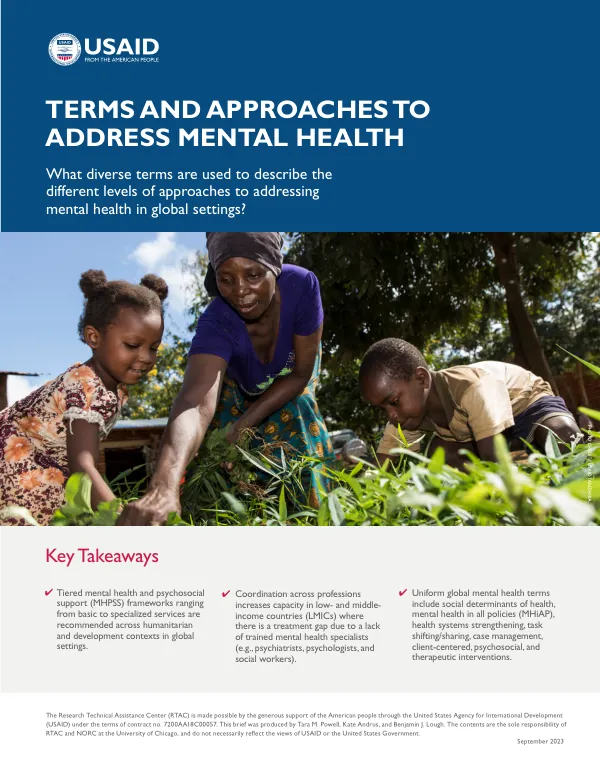
However, a well-documented mental health service and treatment gap exists in low- and middle-income countries (LMICs). Mental health services and interventions span a continuum, including population, systems, community, and individual-level approaches. Terminologies used in global mental health can vary across professions and contexts, creating confusion about the types and levels of mental health approaches. Tiered mental health and psychosocial support (MHPSS) frameworks are recommended across humanitarian and development contexts in global settings. These frameworks range from basic to specialized services, with the goal of addressing the mental health needs of individuals and communities. The Research Technical Assistance Center (RTAC) has developed a framework for MHPSS, which includes four tiers of service delivery. The first tier emphasizes addressing basic needs, such as food and shelter, and ensuring safety for crisis-affected individuals and communities. The second tier focuses on establishing community and family support, while the third tier emphasizes "focused, non-specialized support" for those needing more intensive psychological support. In emergency settings, the Inter-Agency Standing Committee (IASC) pyramid provides guidance for delivering MHPSS services. This approach recommends a four-tiered, multi-sectoral service delivery model, with tailored specialized services, such as counseling or psychiatric support, provided for those with significant mental health needs. The IASC also recommends providing multi-layered psychological support depending on the needs of the individual and community. Coordination across professions is essential in LMICs, where there is a treatment gap due to a lack of trained mental health specialists. Uniform global mental health terms include social determinants of health, mental health in all policies (MHiAP), health systems strengthening, task shifting/sharing, case management, client-centered, psychosocial, and therapeutic interventions. Promising approaches to addressing mental health in global settings include prioritizing and coordinating multi-level interventions, investing in evidence-generating approaches, providing specific guidance on implementing specialized mental health services, coordinating with local governments and other organizations, and involving intersectoral and interprofessional collaboration. The legitimacy of alternative approaches from the Global South can be enhanced by building partnerships with local/indigenous communities and organizations, promoting and funding research into local, non-Western approaches, and providing legitimacy to indigenous approaches. By moving beyond lower-tiered care, guidance can help humanitarian organizations provide tailored or specialized care to people who experience significant trauma.
Related documents