INITIATIVES, INC.
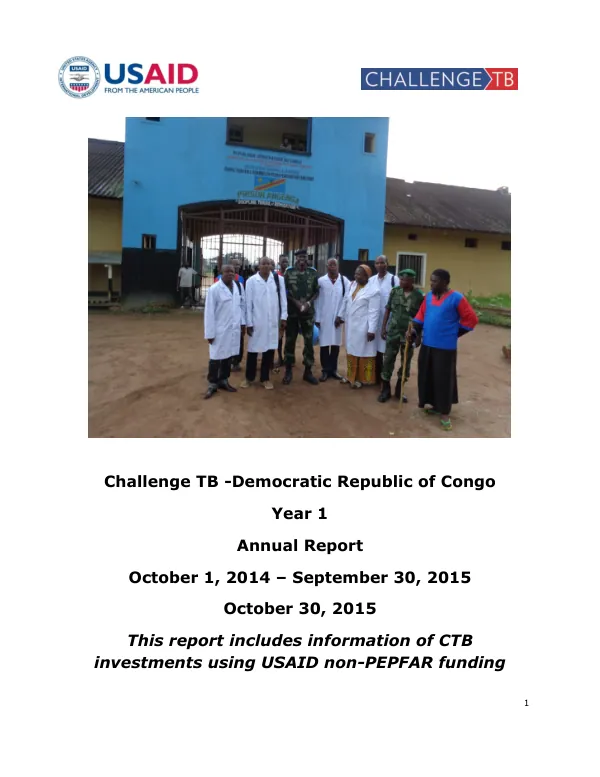
Annual Report: Challenge TB -Democratic Republic of Congo Year 1
The Challenge TB project in the Democratic Republic of Congo (DRC) is a global 5-year initiative funded by the United States Agency for International Development (USAID) to reduce mortality and morbidity from tuberculosis (TB).
2015 · 50 pages
Sign in to readA free account is required to download.
Abstract
The project commenced in February 2015, with the International Union against Tuberculosis and Lung Disease (The Union) as the lead partner. Management Sciences for Health (MSH) is the coalition partner focused on supporting TB-HIV activities, while KNCV Tuberculosis Foundation provides remote technical supervision. The project's strategic objectives in DRC are to improve access to quality TB, TB-HIV, and drug-resistant TB diagnosis and care, prevent transmission and disease progression, and strengthen TB platforms. The total budget for Year 1 was USD 4,526,319 million. The CTB country team operates from offices in Kinshasa and seven Coordination Provinciale contre la Lepre et la Tuberculose (CPLT) locations, with office space provided by the CPLT. MSH works in health zones in five CPLT located in three provinces, namely Katanga, Province Orientale, and Kinshasa, which were already supported by the U.S. President's Emergency Plan for AIDS Relief (PEPFAR). Four local non-governmental organizations (NGOs) are sub-contractors, including the Club des Amis de Damien (CAD), the Ligue Nationale Anti-Tuberculeuse et Anti-Lepreuse au Congo (LNAC), the Fondation Femmes Plus (Femmes Plus), and the Ambassadeurs de lutte contre la Tuberculose du Sud Kivu (ALTB). During the first Annual Plan of Activities (APA1), CTB worked closely with the Ministry of Health (MoH) through the National TB Control Program (Programme National de Lutte contre la Tuberculose, PNLT) and the National AIDS Program at both national and CPLT levels. CTB also coordinated its activities with the principal recipient, the PNLT, to ensure alignment with national priorities. The CTB country office was officially opened in August 2015, and the project has established a strong presence in the DRC. The project's focus on improving access to quality TB care, strengthening TB platforms, and preventing transmission and disease progression is critical to reducing the burden of TB in the DRC. The project's activities are implemented in seven provinces, including Equateur East, Kasai Oriental Sud, Kasai Occidental East, Kasai Occidental Ouest, Maniema, Sankuru, and Sud Kivu. The project's geographic focus is on these provinces, where the burden of TB is highest. The project's timeframes are aligned with the global project's 5-year duration, with the first year (2015) focusing on establishing the project's presence, building partnerships, and developing a strong implementation plan. The project's recommendations for future activities are based on the lessons learned during the first year and the needs identified in the DRC. The project's implementation details are outlined in the Annual Plan of Activities (APA1), which provides a comprehensive plan for the project's activities, including the objectives, strategies, and indicators for each activity. The project's financial report for Year 1 is also included in the annexes, providing a detailed breakdown of the project's expenditures. The project's geographic focus is on the DRC, where the burden of TB is highest. The project's activities are implemented in seven provinces, including Equateur East, Kasai Oriental Sud, Kasai Occidental East, Kasai Occidental Ouest, Maniema, Sankuru, and Sud Kivu. The project's geographic focus is critical to reducing the burden of TB in the DRC.
Related documents