MINISTÈRE DE LA SANTÉ PUBLIQUE ET DE LA POPULATION
Drought Emergency Social Assistance for Haiti (DESAH)
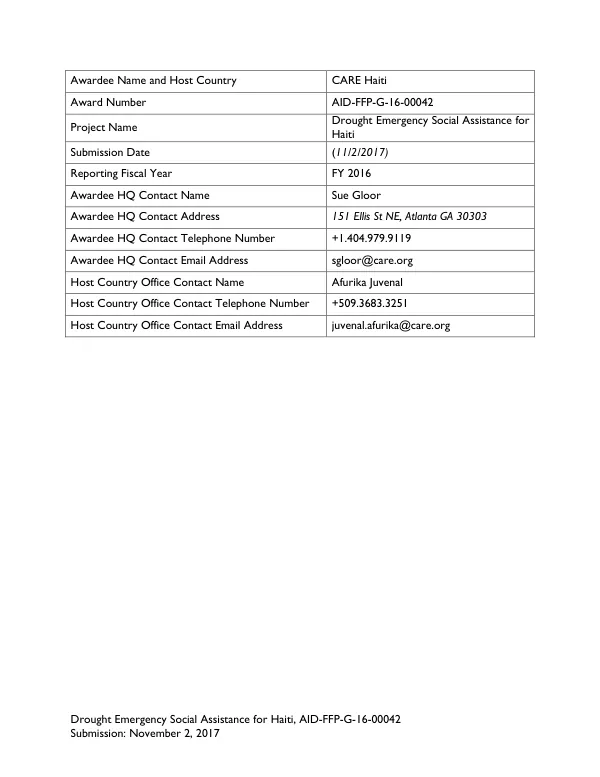
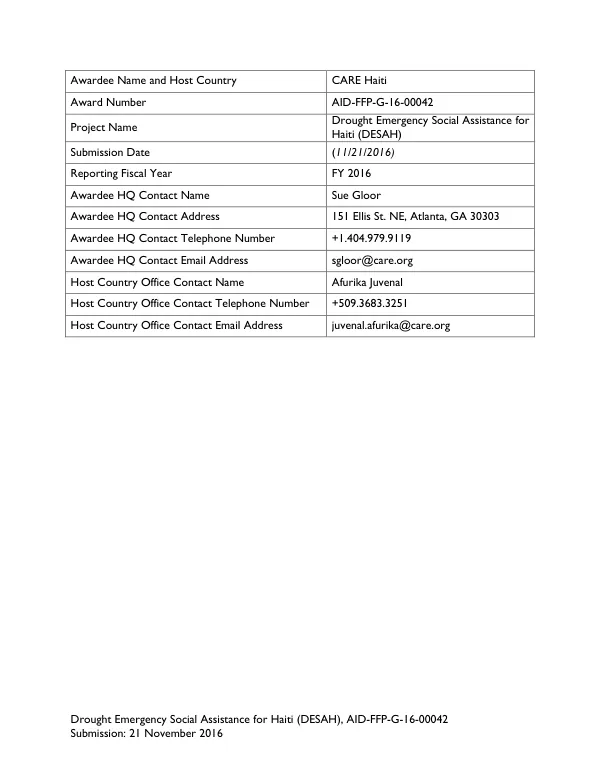
The Drought Emergency Social Assistance for Haiti (DESAH) project was implemented in response to the 2015/2016 El-Nino drought crisis in Haiti.
2016 · 51 pages
Sign in to readA free account is required to download.
Abstract
The project aimed to protect and improve the livelihoods of 14,785 households (80,000 people) in two communes of the Central Plateau Department and four communes of the South-East Department. CARE, the implementing partner, received funding from the United States Agency for International Development (USAID) through the Food for Peace (FFP) program. The project had two components: immediate income support to access critical food and livelihood needs, and future resilience of drought-affected communities. A total of $250 USD was transferred to 14,785 selected beneficiary households over the project period, resulting in an investment of approximately 590,000 person-days in community physical assets such as rehabilitation of micro-watersheds/catchments for water source productivity and dry season farming, low-cost rainwater reservoirs, and market and sanitation infrastructure. The project outputs included social cash transfers, recapitalization of community-managed social funds and/or risk management initiatives, and community nutrition awareness-raising activities. By the end of May 2016, CARE had formally contracted two Micro Finance Institutions to process transfers to beneficiaries, with the Regional Credit Union for Economic and Social Promotion (CREPES) selected for the South-East Department and the Savings and Credit Cooperative of Lascahobas (COOPECLAS) selected for the Central Plateau Department. In the South-East Department, all 7,715 beneficiary households were selected by April 2016, while in the Central Plateau Department, 6,833 beneficiary households of the 7,070 initially planned were selected by May 2016, with an additional 507 households integrated into the project in July. The project also supported Village Savings and Loan Associations (VSLA) groups, with 30 high-performing groups in the Central Plateau selected and signed an agreement with CARE, receiving a total of $40,968 to buy seeds and plant them in August. The project's programming performance included the identification of 15,048 households (6,750 female or 45%) as beneficiaries, with 13,236 households (88%) engaged in physical asset development, 891 households (6%) engaged in social work, and 921 households (6%) receiving direct cash transfers. The project also supported community nutrition awareness-raising activities and planning and monitoring of community assets by local and government structures. The project's geographic focus was on the Central Plateau and South-East Departments of Haiti, with a total of 14,785 households targeted in two communes of the Central Plateau Department and four communes of the South-East Department. The project's timeframes were from February 2016 to November 2016, with the project period extending to May 2017. The project's recommendations included the continuation of support to drought-affected communities, the strengthening of community-managed social funds and/or risk management initiatives, and the promotion of community nutrition awareness-raising activities.